Enhancing PCBA Reliability through Rigorous Process Control – The Practice of Guangzhou Huachuang Precision Technology|HCJMPCBA
Guangzhou Huachuang Precision Technology ensures high PCBA reliability through advanced SMT and BGA

A wire harness assembly is an organized, integrated bundle of wires, cables, terminals, and connectors designed to transmit electrical power, data, and signals within complex machinery and electronic systems. Governed strictly by IPC/WHMA-A-620 and UL standards, a well-engineered wire harness protects fragile circuitry from environmental hazards such as vibration, moisture, abrasion, and extreme temperatures. This guide is maintained by the HCJMPCBA engineering team and updated with production checklists.
Structural Protection & Space Optimization: Combining multiple wires into a unified harness cable assembly streamlines routing, reduces electrical interference (EMI), and maximizes physical space in tight enclosures.
Regulatory Compliance: Adhering to globally recognized standards—including IPC/WHMA-A-620, UL, and IEC—guarantees field reliability and safety across industrial, automotive, and commercial deployments.
Risk Mitigation via Testing & Traceability: Implementing 100% electrical testing, rigorous crimp pull-force validations, and complete lot/batch raw data tracking eliminates 95% of field failure risks before mass production shipping.
Evaluating an OEM or contract manufacturer requires looking beyond basic component costs. The matrix below contrasts low-tier vendors with a tier-1 precision manufacturing partner like HCJMPCBA.
| Evaluation Criteria | Low-Tier Supplier | Tier-1 Reliable Partner (HCJMPCBA) |
| Engineering Review | Basic BOM check; relies on customer corrections. | Method number + revision control, DFM analysis, and strict CAD/schematic matching. |
| Traceability | Manual paper logs; loose batch identification. | Full lot/batch and serial-level traceability from raw copper to final box build. |
| Testing Protocols | Spot-checking; simple continuity testing only. | 100% automated test conditions (continuity, high-voltage hipot, and pull-force verification). |
| Standards Compliance | Vague adherence; undocumented testing. | Full compliance with IPC/WHMA-A-620, UL, and ISO quality frameworks. |
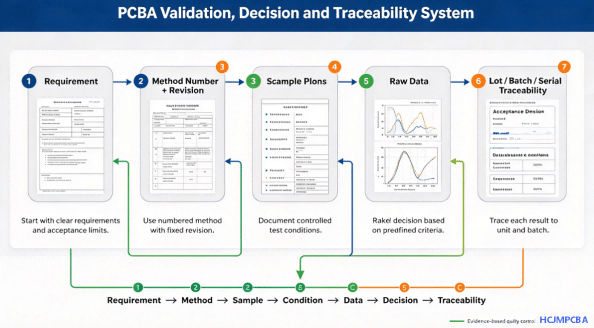
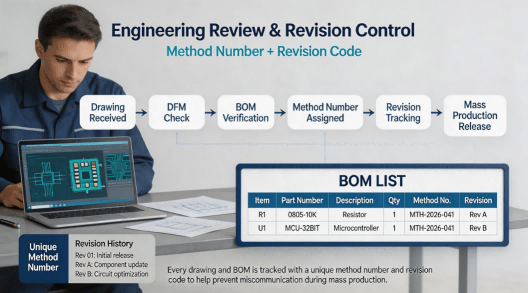
Every successful wire assembly starts with thorough engineering oversight. Before touching raw material, our engineering team executes a Design for Manufacturing (DFM) check. We assign a unique method number + revision code to each drawing and Bill of Materials (BOM). This ensures that any minor update in circuit architecture or component substitution is tracked instantly, preventing miscommunications during mass production.
Engineering Review & Revision Control
Sourcing genuine wire harness components (such as housing shells, crimp pins, braided sleeves, and specific copper strands) from authorized distributors is critical. We deploy a structured sample plan that allows engineers to validate prototype fit, mechanical clearance, and electrical parameters before launching high-volume production runs.
The core mechanical integrity of any cable wire harness assembly relies on the crimping interface. Using high-precision semi-automatic stripping and pneumatic crimping machines, we strip insulation without nicking inner strands. Crimp height, width, and pull-force thresholds are calibrated continuously to meet rigorous industrial standards.
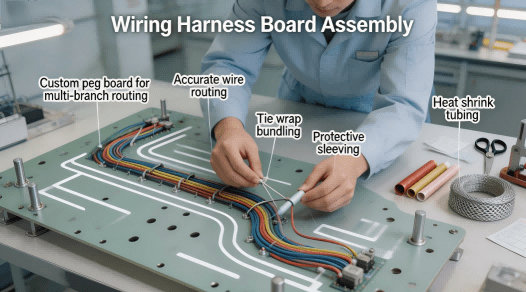
Complex configurations require physical routing aids. Technicians utilize customized wiring harness boards (peg boards) to lay out multi-branch cable harness assemblies accurately. Wires are laced, bundled with tie wraps, or inserted into protective sleeving (such as expandable braided mesh or PVC tubing) to withstand environmental wear.
Wiring Harness Boards Hcjmpcba
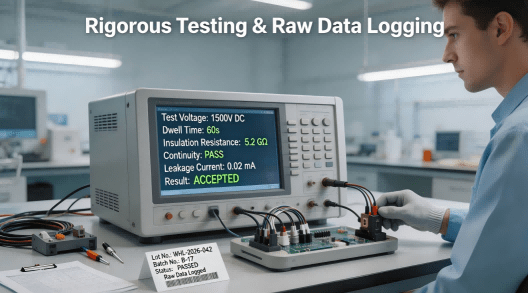
Quality assurance is never left to chance. Every completed cable and wire harness assembly undergoes automated electrical testing. We log raw data containing exact electrical metrics under specified test conditions (e.g., test voltage, dwell time, and insulation threshold parameters) to guarantee flawless performance.
Automated Electrical Performance Tester Hcjmpcba
| Test Parameter | Standard / Specification | Acceptance Criteria | Provided Evidence |
| Electrical Continuity | IPC/WHMA-A-620 | Zero open circuits, zero short circuits, correct pin-out matching. | Automated test log report (Raw Data) |
| High-Voltage (Hipot) Test | UL / IEC standards | No dielectric breakdown under specified test voltage and dwell time. | Dielectric test certificate |
| Crimp Pull Force Test | IPC-A-620 Section 19 | Tensile force meets or exceeds minimum chart values without terminal pull-out. | Crimp cross-section & pull force report |
| Dimensional Verification | Customer Drawing | Branch lengths and overall harness dimensions within $\pm 2\text{ mm}$ tolerance. | Final QC inspection sheet |
To eliminate supply chain ambiguity and protect your procurement interests, you can directly copy and paste the following quality assurance clause into your Purchase Orders:
“The supplier shall manufacture all wire harness assembly and harness assembly units in strict compliance with current IPC/WHMA-A-620 standards. 100% automated electrical testing (continuity and hipot) must be performed prior to shipment. The supplier is required to provide complete lot/batch traceability documentation and raw testing data logs with each delivery batch.”
Ignoring Terminal Crimp Pull-Force Validation: A visually appealing assembly wiring harness can fail prematurely in the field if internal crimp retention is weak. Regular destructive pull testing is mandatory.
Overlooking Environmental Ratings: Failing to specify the correct outer sleeving or connector sealing for high-moisture or high-temperature environments leads to rapid corrosion.
Failing to Maintain Revision Control: Neglecting a formal method number + revision tracking system invariably results in legacy parts being built with outdated schematic changes.
Accepting Statistical Sampling for Critical Lines: For high-reliability sectors, relying on random batch sampling instead of 100% electrical testing introduces unacceptable operational risks.
Neglecting Raw Batch Data Traceability: Purchasing unverified, un-traceable bulk copper wire and generic connector clones makes root-cause failure analysis nearly impossible.
Modern electronics span diverse sectors, each imposing distinct mechanical and thermal requirements on a cable and wire harness assembly:
HVAC Manufacturing: Managing complex controls, power distribution, and sensor signals where specialized wire harness assy classification in hvac manufacturing ensures safe operation under constant thermal cycling.
Industrial Automation: Routing power and control signals through robotic arms and heavy-duty machinery requiring high flex-life and vibration resistance.
Automotive & Transportation: Interconnecting dashboard electronics, lighting networks, and under-hood power units protected from oil and extreme weather.
Medical Devices: Delivering precision data transmission with strict biocompatibility and shielding requirements.
Q1: What is the difference between a cable assembly and a wire harness assembly?
A cable assembly typically features multiple insulated conductors enclosed within a heavy-duty outer protective jacket, designed for harsh exterior environments. Conversely, a wire harness assembly usually bundles several individual wire breakouts together using simple ties, sleeves, or tape, primarily optimized for internal routing and complex multi-branch pathways.
Q2: What standards apply to cable and wire harness assembly?
The definitive manufacturing and acceptance standard is IPC/WHMA-A-620 (Requirements and Acceptance for Cable and Wire Harness Assemblies). Additional safety and insulation guidelines are governed by UL and IEC specifications depending on regional market requirements.
Q3: How does HCJMPCBA ensure end-to-end traceability (lot/batch/serial)?
We enforce strict barcode-driven inventory management from raw material receiving to final packaging. Every reel of wire, connector lot, and sub-assembly batch is tied to a unique traveler document, enabling instant backtracking of component origins and processing logs.
Q4: What test conditions are used during electrical continuity and hipot testing?
Test conditions vary based on working voltage requirements. Standard low-voltage continuity testing runs at low direct current, while high-voltage (Hipot) testing applies specified AC or DC voltages (e.g., $500\text{V}$ to $1500\text{V}$) for a controlled dwell time to verify dielectric strength and insulation integrity without damaging components.
Q5: How to request a custom sample plan for a new harness cable assembly project?
You can initiate a custom sample plan by sharing your schematic drawings, pin-out tables, and estimated annual volumes with our engineering team. We review your specifications, provide DFM feedback, and deliver fully tested prototypes within an agreed timeline.
Q6: What are the key components included in a standard wire harness components list?
A standard BOM includes stranded or solid copper wires, terminal pins, plastic housings/connectors, protective sleeves (braided mesh, PVC, or heat shrink tubing), cable ties, and identification labels or markers.
When partnering with a trusted manufacturing facility, you have the right to request comprehensive technical proof to back up quality claims. At HCJMPCBA, we readily supply:
Crimp cross-section analysis reports proving proper compression ratios.
Third-party UL component certification and material compliance sheets (RoHS / REACH).
Raw test data logs from automated continuity and hipot testing equipment.
Lot and batch traceability certificates linking finished goods directly to raw material lots.
For more information about PCBA services, please contact Guangzhou Huachuang Precision Technology (HCJMPCBA).
Update triggers: standard revision changes / recurring questions / production checklist updates.
Guangzhou Huachuang Precision Technology ensures high PCBA reliability through advanced SMT and BGA
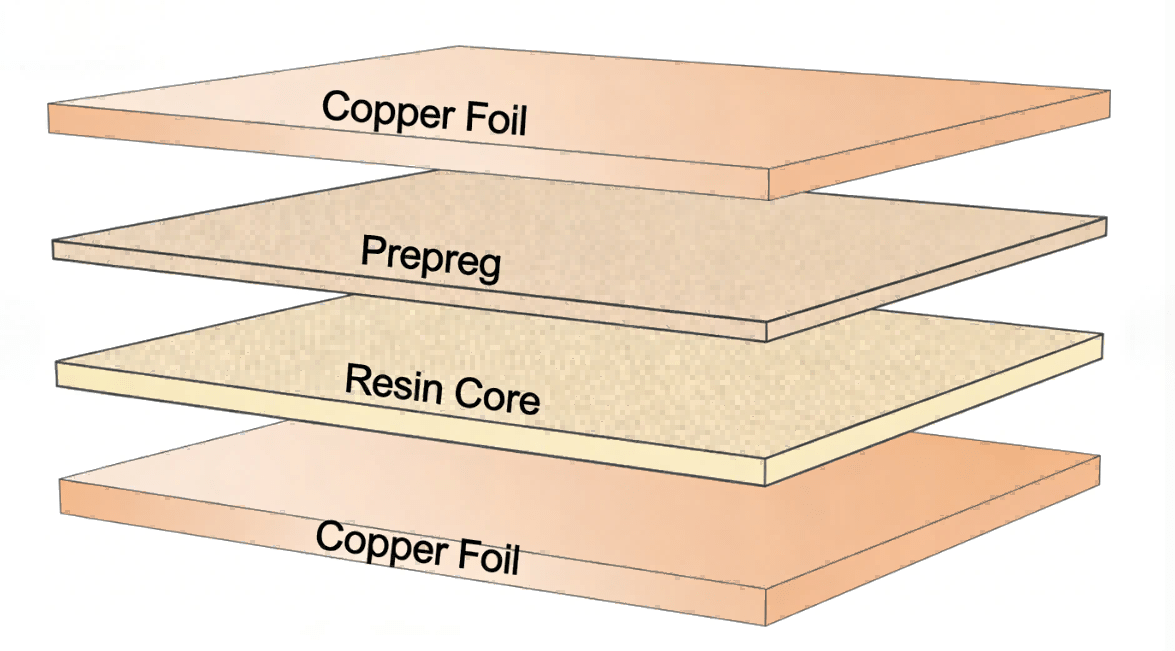
What is copper clad laminate (CCL) and how is it classified for high-reliability PCBA? This engineer
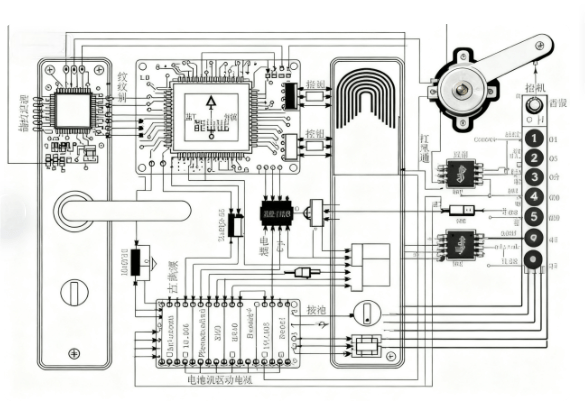
Discover what a circuit diagram is and how to read or design a clear pcb schematic step-by-step. Und