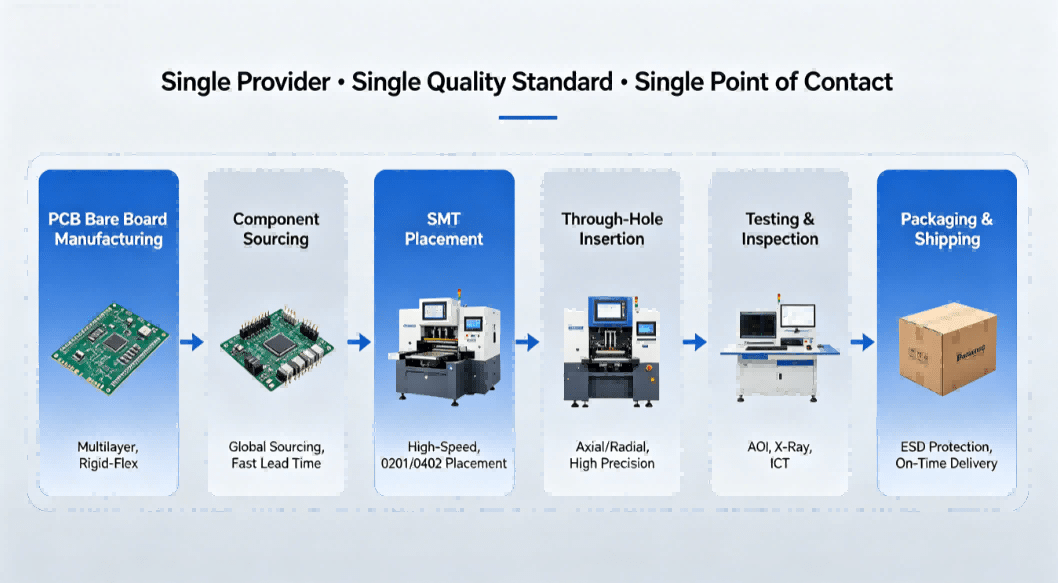
Full-Service PCB Manufacturing: From Prototype to Production
Full-service PCB manufacturing streamlines your supply chain from bare board fabrication to assemble

IPC-TM-650 is the official test methods manual published by IPC (Association Connecting Electronics Industries) for printed circuit boards (PCB), PCB materials, and PCBA reliability validation.
It contains standardized laboratory and manufacturing test procedures used across the global electronics industry to verify:
– thermal reliability
– solder mask adhesion
– ionic contamination
– copper thickness
– insulation resistance
– CAF resistance
– dielectric performance
– environmental durability
IPC-TM-650 is not a single test standard. Instead, it is a structured library of hundreds of individual test methods organized by technical category.
For example:
– IPC-TM-650 2.4.22 = Thermal Stress Testing
– IPC-TM-650 2.3.25 = Peel Strength
– IPC-TM-650 2.6.3.7 = Surface Insulation Resistance
In practical PCB manufacturing, IPC-TM-650 helps engineers, OEMs, and PCBA factories ensure test consistency, repeatability, and traceable quality verification across different suppliers and laboratories.
At Guangzhou Huachuang Precision Technology (HCJMPCBA), IPC-TM-650 methods are integrated into process verification, reliability validation, and manufacturing quality control workflows for high-reliability electronics production.
1.IPC-TM-650 is a method library, not a single test—precision comes from selecting the right method family and locking execution conditions.
2.The “secret” of reproducible results is documentation: method number + revision + sample definition + conditions + raw data.
3.The best programs use IPC testing to close the loop: test results feed back into manufacturing controls and supplier alignment, not just end-of-line acceptance.
IPC-TM-650 and IPC-A-610 serve completely different purposes in electronics manufacturing.
IPC-TM-650 defines standardized laboratory and engineering test methods used to evaluate PCB materials, solderability, insulation resistance, thermal reliability, contamination levels, and environmental durability.
IPC-A-610, by contrast, defines acceptability criteria for electronic assemblies. It specifies whether solder joints, component placement, and assembly workmanship meet visual quality standards.
In simple terms:
– IPC-TM-650 = HOW to test
– IPC-A-610 = WHAT is acceptable
Both standards are widely used together in PCB and PCBA manufacturing environments.
IPC-TM-650 is a published manual from IPC that consolidates test procedures used to validate printed boards, connectors, and related materials. The methods cover multiple categories—chemical, mechanical, electrical, environmental, visual, and dimensional—so that different organizations can run tests using a consistent procedure language and produce comparable evidence.
In practical procurement terms: IPC-TM-650 helps prevent the phrase “we ran an IPC test” from becoming meaningless. It turns that phrase into something verifiable, such as:
exact method reference
current revision/status
sample plan and preparation rules
test conditions
pass/fail criteria
raw measurement outputs and traceability
It is not a single “certificate” that proves a board is good. It’s a set of procedures you can use to verify specific characteristics.
It is not automatically an acceptance standard by itself. Acceptance needs a defined criterion (often derived from contract specs, product requirements, or referenced standards).
It is not a guarantee that two labs will match if they run different revisions or different sample preparation steps. Reproducibility requires alignment.
Some IPC-TM-650 methods are widely used in PCB and PCBA manufacturing environments:
| IPC-TM-650 Method | Purpose |
|—|—|
| 2.4.22 | Thermal Stress Testing |
| 2.3.25 | Peel Strength Testing |
| 2.6.3.7 | Surface Insulation Resistance |
| 2.3.28 | Ionic Cleanliness Testing |
| 2.4.8 | Solder Mask Adhesion |
| 2.4.13 | Flexural Strength |
These methods are commonly referenced in high-reliability industries such as industrial control systems, robotics, automotive electronics, and medical PCBA manufacturing.
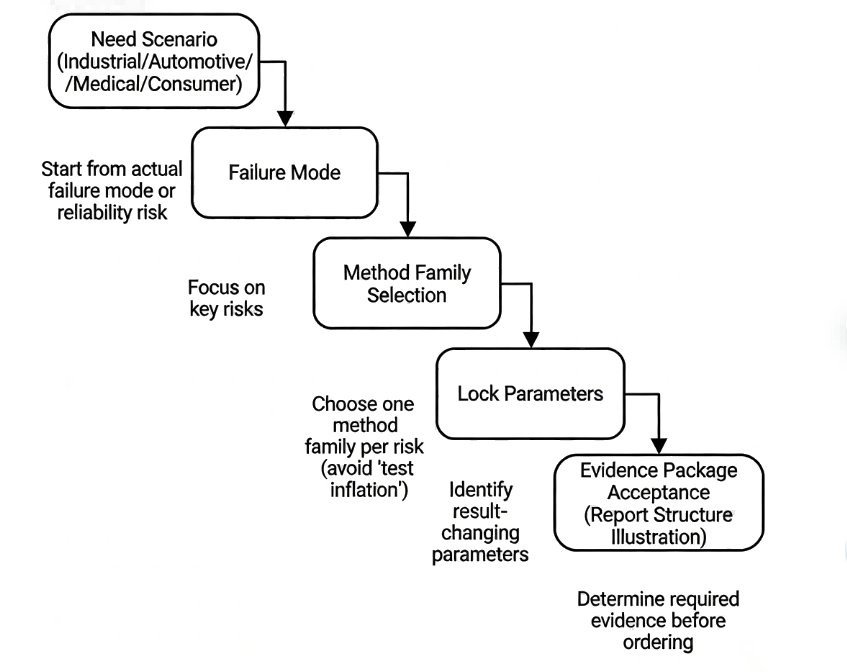
IPC-TM-650 groups methods across broad technical categories (for example, environmental and electrical testing). This structure makes it easier to select the right family based on the risk you are trying to control—rather than randomly collecting tests.
A useful internal habit is to label each method you select with:
Risk it mitigates (failure mode)
What it measures (property)
How it is executed (method + conditions)
What evidence is produced (report contents)
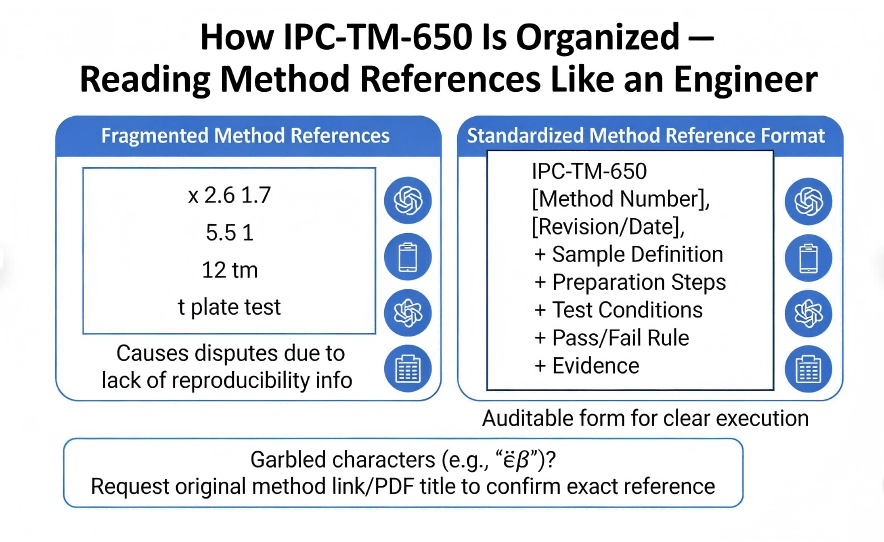
In real purchasing and engineering emails, method references often arrive as fragments such as:
“x 2.6 1.7”
“5.5 1”
“12 tm”
“t plate test”
These fragments cause disputes because they lack the information needed for reproducibility. A “method reference” should be upgraded into an auditable form:
Best practice reference format
IPC-TM-650 [Method Number], [Revision/Date], plus:
sample definition (coupon type, location, quantity)
preparation steps (cleaning, bake, conditioning)
test conditions (time, temperature, voltage, chemical concentration)
pass/fail rule or reporting threshold
If your team receives garbled characters (for example, “єь”) inside a spec or email, treat it as a transcription error and request the original method link or PDF title so you can confirm the exact reference.
How Ipc Tm 650 Is Organized Hcjmpcba
The table below is designed to be “forwardable” inside engineering and procurement threads. It focuses on how to choose what to do, not on memorizing the manual.
| Quality Risk / Failure Mode | What to Test (Goal) | IPC-TM-650 Method Family (by technical category) | Key Parameters to Lock | What Evidence to Require |
|---|---|---|---|---|
| Solder mask lifting / poor adhesion | Solder mask adhesion and robustness | IPC-TM-650 testing methods for solder mask (adhesion/tape-type procedures exist) | substrate finish, cure profile, test area definition, tape type/force, dwell time | method+revision, photos before/after, failure mode notes |
| Thermal cycling / copper cracking risk | Thermal stress test to reveal structural weaknesses | Environmental / thermal stress method family (example: thermal stress test references exist in IPC testing discussions) | ramp/soak conditions, coupon design, preconditioning, inspection criteria | method+revision, cycle profile, microsection/inspection outputs |
| Electrochemical migration / CAF risk | Propensity for electrochemical failure | Environmental/electrical reliability method family (CAF-related methods exist) | voltage bias, humidity, spacing, coupon geometry, duration | method+revision, bias conditions, failure definition, raw logs |
| Dimensional instability / warpage | Board geometry stability | Dimensional / mechanical method family | measurement approach, fixture, sampling locations, preconditioning | method+revision, measurement logs, equipment calibration |
| Cleanliness / ionic contamination | Residual contamination level | Chemical/cleanliness test method family | extraction method, solvent, time/temp, reporting units | method+revision, raw readings, lot traceability |
| Electrical integrity | Insulation performance / continuity | Electrical test method family | test voltage, dwell time, pass thresholds, sample count | method+revision, test conditions, pass/fail report |
How To Use This Decision Table Hcjmpcba
Instead of “high reliability,” translate into measurable statements:
What characteristic must be verified?
Under which conditions?
With what pass/fail rule?
How will it be documented and traced?
A good statement is measurable and leaves little room for interpretation.
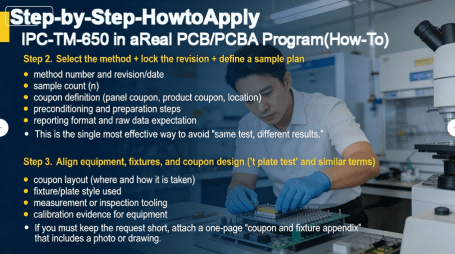
A method number alone is not enough. Your test request should specify:
method number and revision/date
sample count (n)
coupon definition (panel coupon, product coupon, location)
preconditioning and preparation steps
reporting format and raw data expectation
This is the single most effective way to avoid “same test, different results.”
Terms like “t plate test” often mean different fixtures or coupon styles across organizations. Even if the method procedure is standardized, fixtures and sample geometry can change outcomes.
Before testing, align:
coupon layout (where and how it is taken)
fixture/plate style used
measurement or inspection tooling
calibration evidence for equipment
If you must keep the request short, attach a one-page “coupon and fixture appendix” that includes a photo or drawing.
A professional IPC test report should not be “Pass.” It should include the pathway from method reference to data:
method and revision
conditions
sample identifiers
raw measurement outputs
photos/microsections where relevant
signature/approval fields
This aligns with IPC’s emphasis that test methods are advisory procedures and that users must apply them responsibly in context.
The highest-value use of IPC testing is to reduce future escapes:
If a solder mask adhesion issue appears, review cure profile, surface prep, and handling steps.
If thermal stress reveals risk, review drilling parameters, plating, and material selection.
If cleanliness trends worsen, review cleaning chemistry, rinse controls, and drying/bake steps.
Testing that never becomes process control is expensive documentation with limited value.
How To Apply Ipc Tm 650 In A Real Pcb Pcba Program Hcjmpcba
Solder mask issues often show up late: assembly defects, cosmetic rejects, or field exposure problems. A solder mask method request should clarify:
what surface finish is present under the mask
cure process and handling assumptions
the exact adhesion/robustness procedure reference and revision
how failures are documented (photos, peel behavior, location mapping)
Even for experienced teams, solder mask testing becomes inconsistent when documentation is incomplete. Adhesion-type solder mask procedures are documented in IPC test method references.
Thermal stress tests are common in reliability screening, but comparability collapses when:
the temperature profile is described loosely
coupon design is not aligned
inspection definition is inconsistent
In some industry discussions, thermal stress test data is used as an early warning correlated with manufacturing risks such as copper cracking. The point is not the correlation itself; the point is that the test becomes valuable only when it is executed and recorded consistently.
Stating “IPC-TM-650” without the method number and revision, making results impossible to reproduce.
Reporting only “Pass/Fail” without raw data, conditions, or sample plan—no one can verify it later.
Ignoring sample preparation differences (cleaning, baking, conditioning), then wondering why labs disagree.
Treating fixture terms (like “t plate test”) as universal without aligning coupon geometry and tooling.
Copy/paste errors (including garbled text such as “єь”) entering a specification—then the wrong method is executed.
Is IPC-TM-650 a certification?
No. IPC-TM-650 is a collection of test methods, not a certification program.
Who publishes IPC-TM-650?
IPC (Association Connecting Electronics Industries).
What is the difference between IPC-TM-650 and IPC-A-610?
IPC-TM-650 defines testing procedures, while IPC-A-610 defines electronic assembly acceptability criteria.
Is IPC-TM-650 mandatory?
It depends on customer specifications and industry requirements.
Where is IPC-TM-650 used?
PCB manufacturing, PCBA assembly, material validation, reliability engineering, and laboratory testing.
Full-service PCB manufacturing streamlines your supply chain from bare board fabrication to assemble
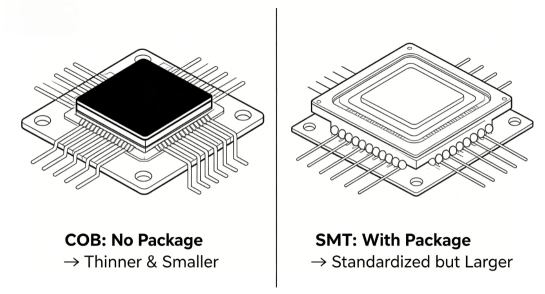
Chip-on-board (COB) assembly mounts bare semiconductor die directly onto PCBs, eliminating package h
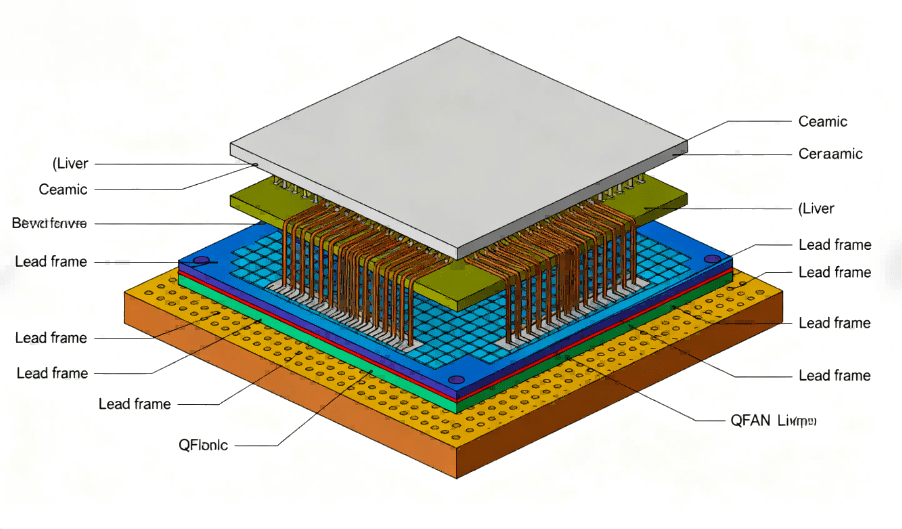
Discover what a QFN package with lid really means — its structure, advantages, thermal and electri