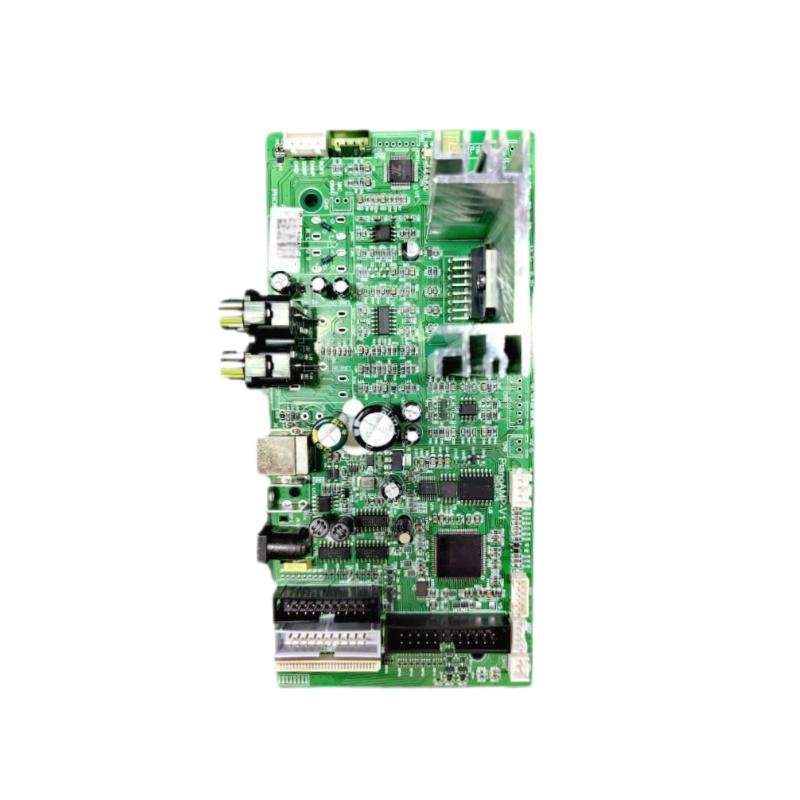
An Arduino turns a low-cost microcontroller into a device that senses, decides and acts — read a sensor, switch a relay, drive a motor, push data onto a network. The useful arduino projects in 2026 are the ones with a job to do: measure something, control something, let someone in, or send a number somewhere it can be acted on. Everything else is a demo.
This guide is maintained by the HCJMPCBA engineering team and updated with production checklists.
Three things worth knowing before you pick a project
Pick by failure cost, not by coolness. A soil sensor that dies kills a potted plant. A cold-chain logger that dies costs a pallet of reagents. The build difficulty is comparable; the production requirement is not.
The board you prototype on is rarely the board you ship. An Uno is a teaching board. Production designs move to Nano-footprint modules, ESP32 modules, or a bare MCU placed on the main PCB — and that single decision sets most of the unit cost.
Most builds fail at assembly, not at code. Cold joints, connector choice, conformal coating, batch consistency. None of it appears in a tutorial; all of it appears on a line.
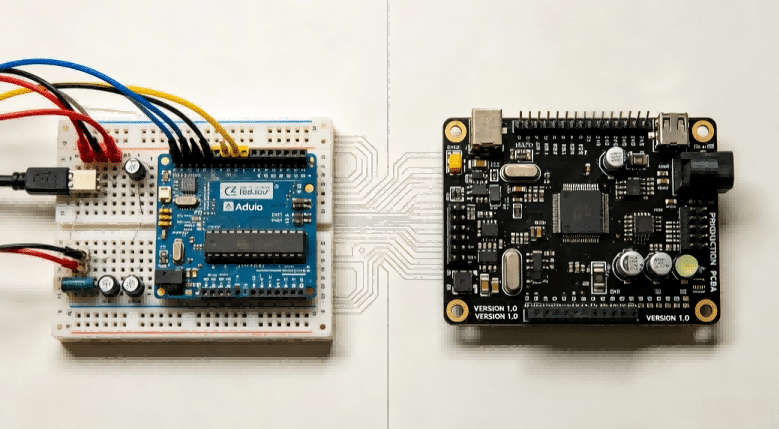
Arduino Projects Compared Breadboard Prototype Beside A Production Pcba Board
Which of these arduino project ideas fits your goal?
Match the goal to the board before reading the list. Half the abandoned builds in the world were started on the wrong one.
| If your goal is… |
Start with |
Parts cost (qty 1) |
Difficulty |
What decides success at 100+ units |
| Measure something outdoors for months |
Nano 33 or ESP32 + breakout |
$18–35 |
Low |
Sealing, sleep current, sensor drift |
| Switch a load safely (valve, pump, heater) |
Nano + MOSFET or SSR |
$25–60 |
Medium |
Isolation, inrush margin, thermal design |
| Talk to factory equipment (24 V, RS-485) |
Nano + isolated transceiver |
$30–70 |
Medium |
EMC, ground potential, address plan |
| Ship a connected product |
Pre-certified ESP32 module |
$22–45 |
Medium |
Antenna keep-out, provisioning, OTA |
| Teach, demo, or prove a concept |
Uno R3-compatible |
$10–20 |
Very low |
Nothing — do not productionize it |
Costs assume single-unit retail buying in early 2026. A production BOM typically lands at 40–60% of these figures before connectors, enclosure and test are added.
Sensing and environment: arduino projects that measure the real world
1. Capacitive Soil-Moisture Irrigation Controller
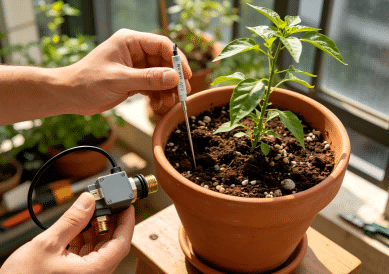
A capacitive probe reads soil water content; below a threshold the board opens a normally-closed solenoid valve. It is one of the few home builds with a measurable payoff — water use drops by roughly a third.
Build note: skip resistive probes, which electrolyse and drift within a season; add 30 seconds of hysteresis so the valve does not chatter at the threshold.
At volume: the probe sets the return rate, not the board. Potting, plating thickness and strain relief at the cable entry decide whether the unit lasts one season or five years.
2. Cold-Chain Temperature Logger
A digital sensor, a real-time clock and an EEPROM circular buffer produce a timestamped curve exported over USB or Bluetooth. For produce and reagents the log is the shipment’s evidence, not a feature.
Build note: vent placement sets response time; 1-minute sampling into 32 KB gives roughly 22 days of history.
At volume: a ±0.2 °C datasheet figure is not a calibration certificate. Regulated buyers ask for the method and the raw points — typically three baths and a signed record per batch.
3. Clamp-On Energy Monitor
A current transformer around one conductor, a burden resistor and an ADC estimate a single machine’s draw. It is the cheapest entry into an energy retrofit, and the payback shows up within a month of data.
Build note: isolation is mandatory, not optional — isolated ADC or opto front end. Reference drift dominates accuracy long before resolution does.
At volume: creepage on the mains side, keyed CT connectors and conformal coating are what separate a bench prototype from something that passes a safety review.
I Can Do This On My Balcony Too
Control and motion: projects that make something move
4. PID-Controlled Reflow Hotplate
A thermocouple, a solid-state relay and a PID loop turn a hotplate into a reflow stage for prototypes — the one build here that shortens a hardware development cycle.
Build note: tune the loop with the plate loaded; thermal lag, not gain, is the problem. Follow the profile windows in IPC/JEDEC J-STD-020 rather than a curve copied from a forum.
At volume: as a lab tool this is a one-off. Productised, mains isolation and enclosure temperature decide certification, and both are mechanical decisions rather than firmware ones.
5. Peristaltic Dosing Pump
A stepper squeezes a tube at a calibrated rate, delivering repeatable volumes for hydroponics, aquariums or bench chemistry — with the fluid never touching the mechanism.
Build note: acceleration ramps matter more than top speed; a stepper started at full rate stalls and doses short. Watch driver junction temperature at low speed.
At volume: flow varies with tube wall thickness, not the motor. Store a per-unit calibration factor in EEPROM during functional test and most field complaints disappear.
6. Conveyor Diverter Gate with Photo-Eye
A photo-eye detects a part, the controller fires a solenoid, the part is routed. Simple logic, unforgiving environment.
Build note: debounce in the 10–20 ms range, then add hysteresis on re-trigger; drive the 24 V side through opto-isolators and keep the logic ground separate from the field ground.
At volume: ground loops and solenoid kickback destroy more units than firmware bugs. Surge and ESD testing to IEC 61000-4-2 and 61000-4-5, plus keyed terminals, is what survives year one on a real line.
7. Greenhouse Vent or Curtain Actuator
A linear actuator opens a vent at a temperature setpoint, with limit switches at both ends and a defined direction on power loss. Growers care about the failure mode more than the setpoint.
Build note: sense motor current for stall detection instead of trusting the limit switch alone; a stuck vent should stop the motor, not burn it.
At volume: relay contact life and IP-rated cable glands. A greenhouse is a condensation chamber with plants in it, and early units die of water rather than of logic.
Interface and access: projects people touch every day
8. Machine-Status Andon Tower Light
Three colours and a buzzer, readable across a shop floor — the cheapest way to make machine state visible without touching the machine’s controller.
Build note: constant-current drive, not a resistor off a 24 V rail that sags. A diffuser buys more perceived brightness than extra lumens.
At volume: colour consistency is a binning problem, not a sourcing one. Specify the bin, then verify it on assembled units — two lights side by side that read as different shades get rejected regardless of function.
9. RFID Access Control with Fail-Safe Logic
A reader, a relay and an electric strike. The interesting decision is not the reader, it is which way the door fails.
Build note: fail-secure suits a store room and fails a fire exit. Decide the direction first, then choose the lock.
At volume: the strike coil draws inrush well above its holding current, so give it a separate supply and a flyback path. Installers ask about tamper switches and backup power before they sign.
10. Wearable Posture and Fall Logger
An inertial measurement unit samples orientation and flags sustained poor posture or a fall. The hard part is defining what counts as an event — logic, not hardware.
Build note: 50 Hz sampling is enough for posture; store counts rather than raw frames if the device must run a week.
At volume: sleep current defines battery life, and three things fail first — pouch-cell protection, flex strain relief at the hinge, and a case that survives being sat on.
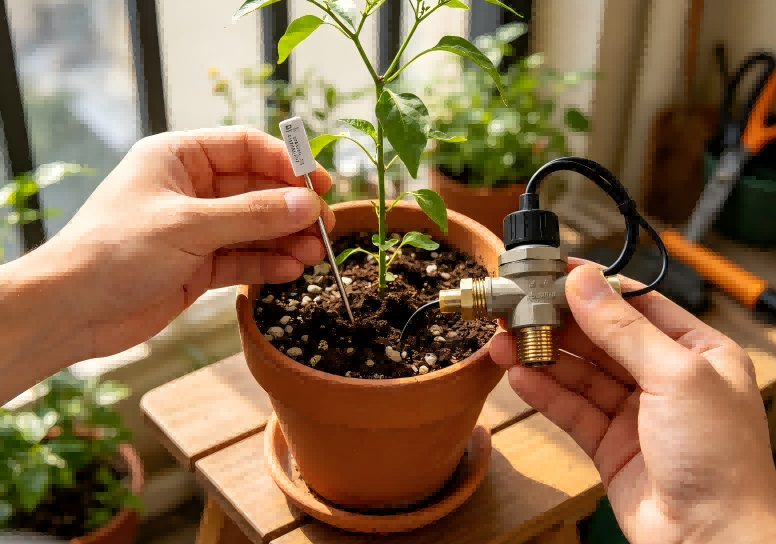
Capacitive Probe Inserted Into Potted Soil
Connectivity and edge: projects that send data somewhere useful
11. ESP32 MQTT Telemetry Gateway
An ESP32 module collects local readings and publishes them to an MQTT broker, buffering when the link drops.
Build note: provisioning is half the product — SoftAP with a captive portal beats hard-coded credentials, and OTA with a rollback partition belongs in the first release, not the second.
At volume: antenna keep-out, a pre-certified module and a provisioning fixture. The same firmware on a badly laid-out board loses 15 dB of range, and no amount of code fixes it.
12. RS-485 Modbus Sensor Node
A nano-class board plus an isolated transceiver makes legacy equipment readable by SCADA. This is where most industrial Arduino work actually happens.
Build note: bias and termination resistors belong on the bus, not on every node; settle the addressing plan before the third device arrives.
At volume: ground potential between buildings destroys a non-isolated transceiver without warning. Specify isolated transceiver, isolated supply and bus protection, then verify with a 1,200 m, 32-node stress test and keep the logs.
13. LoRa Field Node on Solar Power
Long range, low power, charged by a small panel — for farms, campuses and sites where Wi-Fi will never reach.
Build note: start from the energy budget, not the radio. A 5 µA sleep current and a 30-second transmit window decide panel size far more than spreading factor does.
At volume: antenna matching, potting that does not detune the antenna, and a winter worst-case calculation. A node that dies in February was never verified against real irradiance data.
14. ESP32-CAM Inspection Snapshot Station
A camera photographs a part at a fixed position on a trigger. It will not replace a vision system, but it catches missing labels and absent components for almost nothing.
Build note: lighting is 80% of image quality. A diffused ring at a fixed distance beats a higher-resolution sensor, and fixed focus is a feature here.
At volume: lens focus consistency between modules and thermal throttling inside a closed enclosure — both solved mechanically, neither in firmware.
Learning, testing and bench tools
15. Component and Continuity Tester
Measures resistance, capacitance and transistor gain, and beeps on continuity — the question every bench asks twenty times a day.
Build note: 0.1% references and a Kelvin connection for low-ohm work, or lead resistance becomes part of the reading.
At volume: five testers must agree with each other. A shared calibration jig and a recorded self-test keep five benches from producing five different verdicts.
16. Button and Connector Life-Cycle Jig
A solenoid presses a button, a counter tracks cycles, a current monitor watches contact resistance climb. It turns “we think this connector is fine” into a number.
Build note: store the count with wear levelling, or a naive EEPROM write per cycle kills the cell within a week.
At volume: fixtures are products too. They need a maintenance interval and a spare actuator, or the line stops for a reason nobody planned for.
17. UART, I²C and SPI Protocol Sniffer
A pass-through logger captures traffic with timestamps — the fastest way to find out why a sensor “sometimes” returns zero.
Build note: level shifting between 3.3 V and 5 V is not optional; a 5 V bus will eventually find the 3.3 V pin. Size the buffer for the longest burst, then double it.
At volume: not a product. Build five, label them, and keep them at the benches where debugging actually happens.
18. Classroom Sensor Kit with Lesson Cards
Six plug-in modules, one board, a card per lesson. The constraint is not technical: a fifteen-year-old will connect power backwards within ten minutes.
Build note: reverse-polarity protection, screw terminals instead of Dupont headers, and silkscreen that labels every pin in words.
At volume: educational buyers order hundreds and inspect the first one. ESD-safe packaging and consistent joints across the batch are the whole specification.
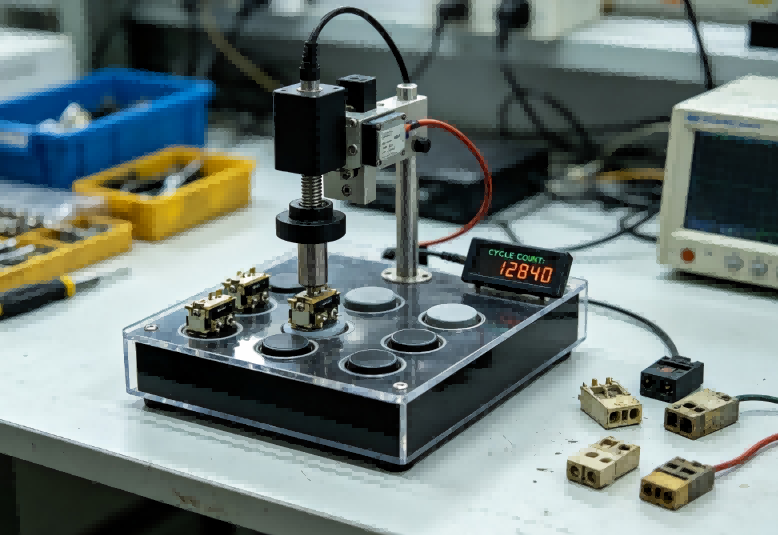
Factory Text
From breadboard to a board you can ship
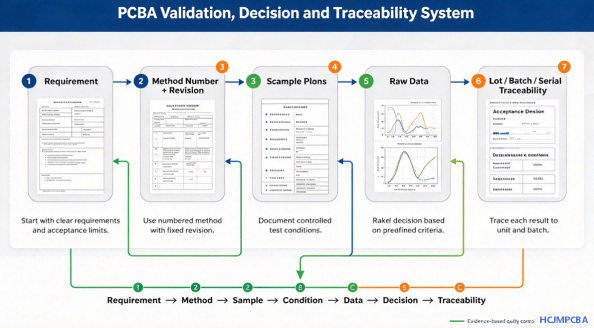
Seven steps, in this order because each one’s output is the next one’s input. Reversing them is how a working prototype becomes a shipment of returns.
1. Freeze the design package. Lock schematic, BOM, Gerber and firmware to a single identifier — a method number with a revision, such as HCJ-2026-041 Rev.C. Verbal changes are void by definition.
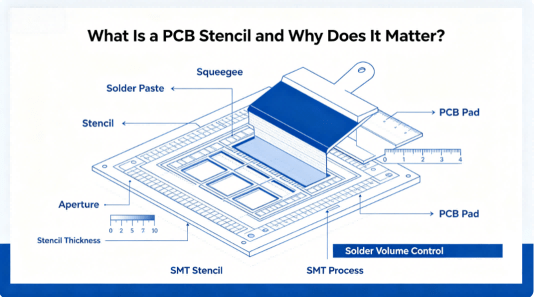
2. Run a DFM review before paying for tooling. Trace width and spacing, pad-to-stencil match, panelisation, process edges, and part availability including end-of-life risk.
3. Agree the sample plan in writing. How many first articles, what sampling level, who signs, and what happens if the first article fails. A quotation without a sample plan is not a quotation.
4. Define test conditions, not test names. “Functional test” is not a condition. Write the input range, load, ambient temperature and humidity, duration and pass limit — for example 24 V ±5%, 40 °C, four hours continuous, output deviation within ±2%.
5. Require raw data rather than a pass stamp. In-circuit and functional logs, AOI defect maps, X-ray void percentage on thermal pads, burn-in curves — delivered with the goods, not summarised after a complaint.
6. Set the traceability chain. Bare-board lot, SMT batch, unit serial, test record, carton ID: four levels, retrievable. A repaired unit must resolve back to a specific batch.
7. Close with a first-article sign-off. Retain the golden sample, compare every later batch against it, and route changes through an ECN. Nothing gets “adjusted during production.”
Assemblers who take steps 1 and 6 seriously rarely submit the lowest quote. They are also the ones who can say which 7 units out of 200 are affected when something goes wrong. That is a procurement risk decision, not a price decision.
How to read a first-article report
A first-article report is not a certificate of quality; it is a snapshot of one unit. What makes it useful is the reference: the drawing revision it was measured against, the instrument used, and the signature that accepted it. Ask for those three fields and the report stops being decoration.
The three documents that matter most
The test specification defines what “working” means. The raw data log proves the specification was applied. The traceability record proves which units it was applied to. Everything else in a quality folder supports these three.
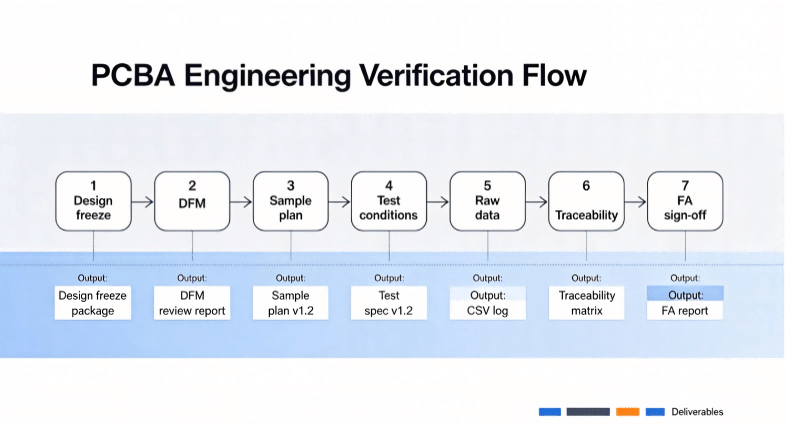
Design Freeze Fa Sign Off
Verification: what to check, and what evidence to ask for
| Check |
Method or standard |
Sample |
Evidence you should receive |
| Solder joint acceptability |
IPC-A-610 Class 2 (industrial/consumer), Class 3 (high reliability) |
AQL plus full first article |
Inspection record with defect map |
| Assembly process control |
J-STD-001 |
Process audit |
Reflow profile per run |
| Bare board integrity |
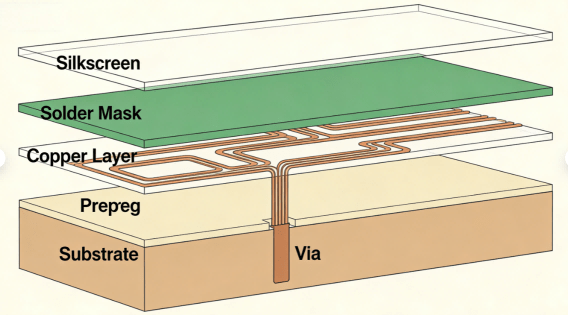
IPC-2221 / IPC-6012 |
First article and batch |
Microsection, impedance test |
| Moisture-sensitive parts |
JEDEC J-STD-020 |
By MSL level |
Bake and floor-life records |
| In-circuit and functional test |
Written test specification |
100%, or agreed sampling |
Raw CSV logs, not a summary |
| Burn-in |
Agreed duration and ambient |
Sampling |
Curves and failure detail |
| Material flammability |
UL 94 V-0 |
Material declaration |
Supplier UL yellow card |
| RoHS and REACH conformity |
EU 2011/65/EU and 2015/863 |
Per batch |
Third-party report number |
Asking for these does not offend a competent supplier. One who cannot produce them is telling you something useful before you place the order.
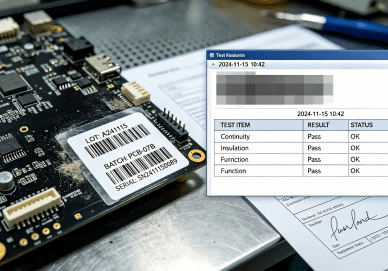
Traceability Label
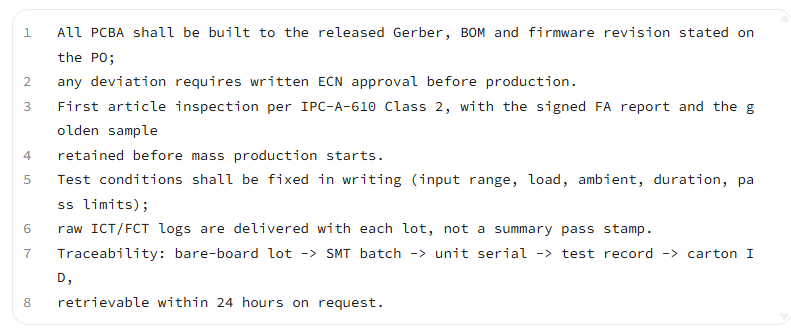
Copy-paste requirement clause for your RFQ
Put these five lines into a request for quotation or a purchase order. They filter out most suppliers who can solder but cannot deliver.
hcjmpcba
Prototyping on a board that will not exist next year. A teaching board defines a shape, not a supply chain. Modules go end-of-life, and a design tied to one module has a shelf life measured in quarters.
A power budget written on paper and never measured. Measured sleep current is routinely three to ten times the estimate. Battery designs fail on this alone, usually at the worst moment.
“Functional test” with no conditions attached. Without an input range and a pass limit, a test is a power-on check — and it will pass a unit that fails in the field at 40 °C.
Connectors chosen last. Most field failures begin at a connector: insertion force, keying, strain relief, plating. They are also the cheapest thing to fix, if decided before the enclosure rather than after.
No revision control between sample and mass production. “Close enough to the sample” is the most expensive sentence in hardware. The sample becomes the contract precisely because memory is unreliable.
A scenario worth studying: five units to five hundred
A small greenhouse contractor built an irrigation controller for its own tunnels, then started selling it. The first five units worked for a season. The next five hundred did not, and the reasons had nothing to do with the code.
Three things broke. Probes from a second supplier drifted at a different rate, so a threshold that suited one batch flooded another. Relay chatter at the threshold wore contacts and produced intermittent watering that looked like a firmware fault. And the enclosure passed a splash test but not a hose, so units came back with water inside and no visible entry point.
The second revision moved all three problems upstream. Probe batches were accepted against a drift test rather than a datasheet, with raw curves kept per lot. Hysteresis was widened and written into the test specification as a measurable parameter. The gasket material changed, and sealing was verified at the specified IP rating rather than by eye.
None of that is exotic engineering. It is the difference between arduino projects that stay prototypes and ones that become products — same board, same firmware, and a process that assumes a batch is not a unit.
Hcjmpcba Smt
FAQ
What can you do with an Arduino that is actually useful?
Four categories cover most of it: measure an environment (temperature, moisture, current), control a load (valve, motor, heater), manage access (cards, codes, interlocks), and move data (Wi-Fi, LoRa, RS-485). A build is worth doing when its output changes a decision someone makes.
What are good arduino projects for a complete beginner?
One sensor, one action: a soil-moisture valve, an andon light, a door sensor with a buzzer. No display, no network. Beginners fail on scope far more often than on electronics.
Which board should I use for something I plan to sell?
Below roughly 50 units, a pre-certified module on a carrier board is the rational choice. Above that, a bare MCU on the main PCB usually wins on cost and mechanical integration. Either way, pick a module family with a documented lifecycle.
How much does it cost to move from prototype to a first production run?
Four blocks: tooling and stencils, first-article and fixture development, components, and compliance testing. The last two dominate. Tooling is a few hundred dollars at the low end; certification is where budgets actually break.
Do I need a custom PCB, or can I ship a module-based design?
Four tests decide it: volume, certification, reliability requirement and unit cost pressure. If any two are high, a custom board pays for itself. If none are, a module design in a good enclosure ships faster and costs less to change.
Why is “Arduino” spelled so many different ways online?
It is an Italian proper noun, and search behaviour reflects that: the board turns up as arduino, ardunio, adruino and audrino, while French-speaking makers type “arduino projets”. All of them describe the same open-source board family, and the spelling does not change the answer to any question on this page.
How do I confirm a supplier builds exactly what I approved?
Four artifacts, in order: the released revision identifier, a signed first-article report against that revision, raw test logs for one full lot, and a traceability lookup on a single serial number. Time the last one. Under an hour is a working system; a week is a filing cabinet.
Evidence you can request from any PCBA partner
- The signed first-article report, plus the golden sample it refers to.
- Raw test logs for one complete lot, with the specification revision they were run against.
- A traceability lookup on one serial number, timed from request to answer.
- The IPC class the line is qualified for, and the date of the last related audit.
- The process change log for the past twelve months.
- Rework and return rates by product family, not company-wide averages.
None of it is commercially sensitive. All of it separates two kinds of supplier within an hour.
If a prototype already runs, the next step is not a cheaper quote. It is running the seven steps above once, properly, and keeping the paperwork. That is also the point at which a conversation about volume makes sense.
For more information about PCBA services, please contact Guangzhou Huachuang Precision Technology(HCJMPCBA).
Update triggers: standard revision changes / recurring questions / production checklist updates.