AOI Inspection PCB: 7 Powerful Insights into Automated Optical Inspection in PCB Manufacturing
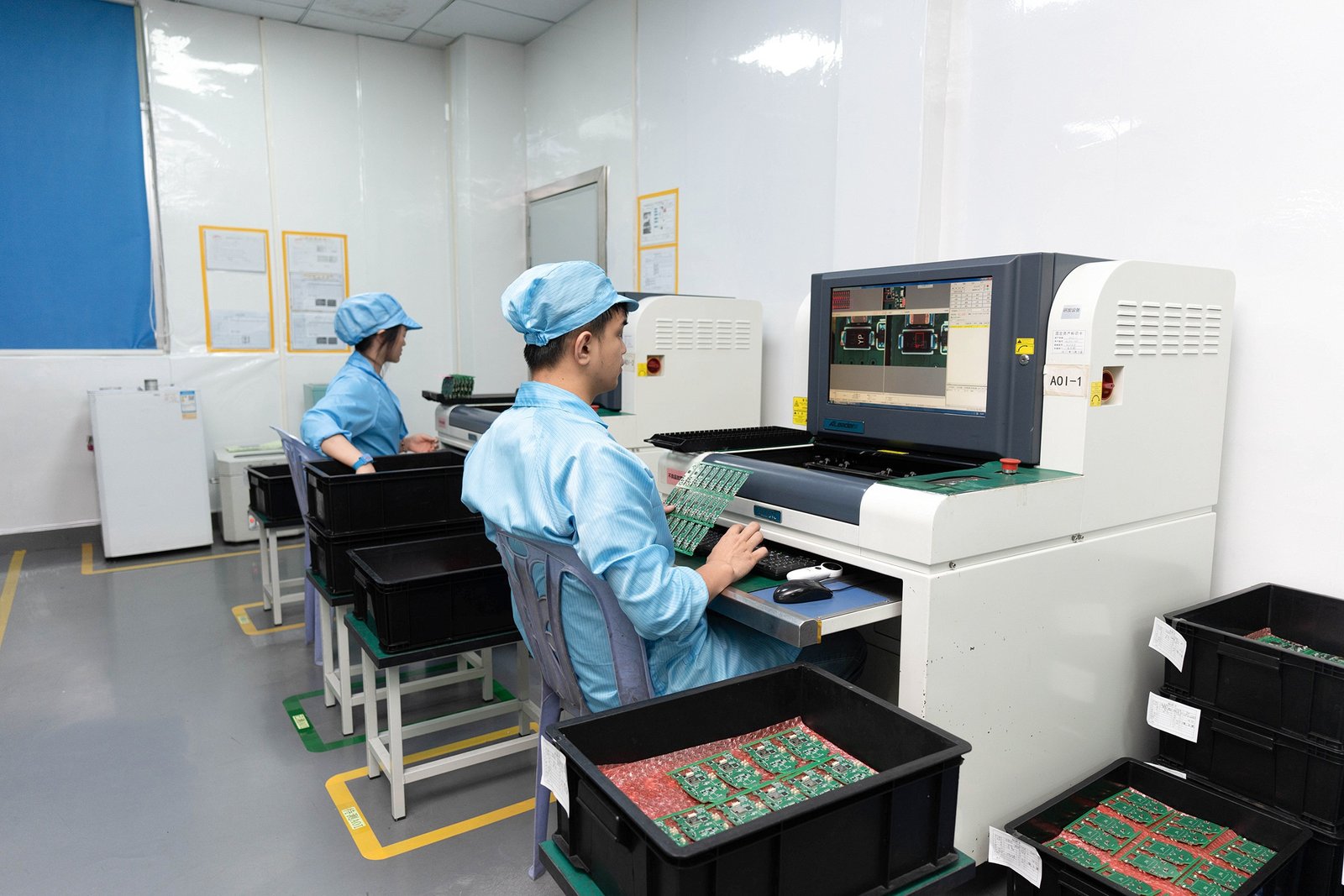
Automated Optical Inspection (aoi inspection pcb) is a non-contact, high-speed quality control metho

The Internet of Things (IoT) consists of physical or virtual things that can be identified, connected, and integrated into communication networks to collect, exchange, process, or act on data. A practical IoT system combines devices, sensing, connectivity, computing, software, and applications to turn information from the physical world into useful services. This concept is consistent with the ITU definition of IoT as interconnected physical and virtual things using interoperable information and communication technologies.
IoT stands for Internet of Things. In simple terms, it describes an ecosystem in which physical or virtual things can be identified and connected through communication technologies so that information can be collected, exchanged, processed, and used.
The ITU definition is broader than the common explanation that IoT simply means “devices connected to the Internet.” It describes IoT as infrastructure that interconnects physical and virtual things through interoperable information and communication technologies, using capabilities such as identification, data capture, processing, and communication to provide services.
This distinction matters when engineers define an IoT product.
A connected device may send data to another device, but an IoT system generally involves a larger chain:
Thing → Sense → Process → Connect → Analyze → Act
For example, an industrial temperature-monitoring device may detect temperature through a sensor, process the measurement using an MCU, transmit the information through Ethernet or wireless connectivity, send it to an edge or cloud platform, and trigger an alarm when a defined threshold is exceeded.
That complete information flow is more representative of IoT than connectivity alone.
A practical way to understand what constitutes IoT is to examine the main elements that work together.
The starting point is the “thing.”
A thing can be a physical object such as:
It can also be associated with information-world objects and software.
The ITU describes an IoT “thing” as an object from the physical or information world that can be identified and integrated into communication networks.
The important engineering question is therefore not simply:
“Does this product have Wi-Fi?”
A better question is:
Can the object be identified, connected, monitored, controlled, or integrated into a broader information system?
Sensors provide an interface between the physical world and an electronic system.
Depending on the application, an IoT device may measure:
For example, an industrial monitoring device may convert physical vibration into electrical signals that an MCU can analyze.
The quality of this first measurement affects everything downstream.
If the sensor data is inaccurate, noisy, unstable, or poorly conditioned, sophisticated cloud software cannot completely compensate for the problem.
For IoT hardware designers, sensing therefore begins at the electronics level—not at the cloud level.
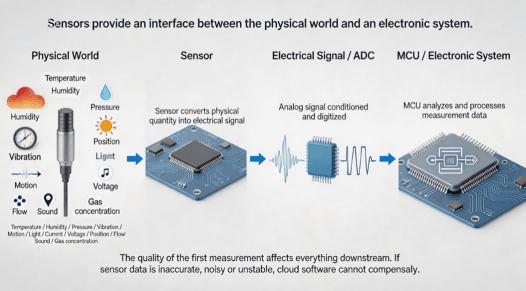
Data Path Actual Temperature — Sensor — Adc — Mcu
IoT devices often contain an MCU, MPU, SoC, or another processing element.
The processor may perform several functions:
Consider a simple industrial temperature-monitoring example:
Sensor detects 82°C → MCU compares the value with a threshold → local warning is triggered → measurement is transmitted → software platform records the event.
The processor therefore acts as a bridge between sensing, communication, and control.
This is also where the PCB becomes important. The processor, memory, sensors, power circuitry, communication module, protection components, connectors, and interfaces must operate together on a physically reliable electronic assembly.
Connectivity enables an IoT device to exchange information with other systems.
Depending on the application, the communication architecture may use:
There is no universal “best” IoT communication technology.
A battery-powered environmental sensor may prioritize low power consumption and long communication range, while an industrial controller may prioritize deterministic communication, reliability, bandwidth, or compatibility with existing infrastructure.
For this reason, connectivity should be considered together with:
Power + Range + Bandwidth + Latency + Environment + Security + Cost
Connectivity becomes valuable when the transmitted information can be interpreted and used.
An IoT system may process data locally at the edge, through a gateway, in a cloud platform, or through a combination of these approaches.
The overall logic can be summarized as:
Data → Information → Decision → Action
For example:
A vibration sensor detects an abnormal pattern.
↓
The local processor filters and analyzes the signal.
↓
The system identifies a possible machine condition change.
↓
Data is transmitted to an application platform.
↓
Maintenance personnel receive an alert.
The value of IoT therefore comes from the relationship between the physical device, data, connectivity, processing, and application—not simply from having an Internet connection.
Modern IoT systems also have to consider security and interoperability.
ISO/IEC 30141:2024 provides a standardized IoT reference architecture with common vocabulary, reusable designs, and architecture/design patterns for IoT systems.
Interoperability is another important consideration. ISO/IEC 21823 addresses interoperability within IoT systems, including how entities exchange and use information. Other parts of the ISO/IEC 21823 series address transport and syntactic interoperability.
For an IoT product, this means engineers should consider questions such as:
A useful simplified architecture is:
| Layer | Main Function | Typical Examples |
|---|---|---|
| Device Layer | Sense and control | Sensors, MCU, actuator |
| Connectivity Layer | Transfer information | Wi-Fi, BLE, Ethernet, cellular |
| Edge/Gateway Layer | Local processing | Gateway, processor |
| Platform Layer | Store and process data | Cloud/server |
| Application Layer | Deliver user functions | Dashboard, mobile app, control software |
ISO/IEC 30141:2024 specifically provides a standardized IoT reference architecture and uses multiple architectural views to support IoT system design.
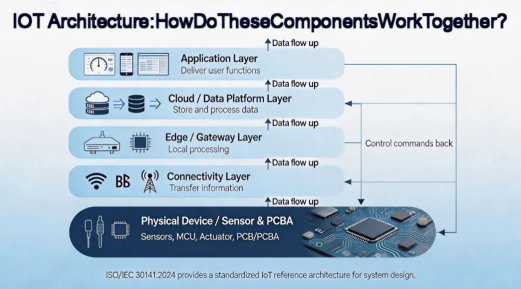
Iot Architecture
Not necessarily.
Internet connectivity alone does not fully describe an IoT system.
For example, a basic connected peripheral may communicate with another device but have little sensing, processing, monitoring, or autonomous application functionality.
By contrast, a connected temperature sensor can:
That combination is much closer to the practical concept of IoT.
| Product | Connected? | Typical IoT Characteristics |
|---|---|---|
| Basic USB peripheral | Yes | Limited |
| Wi-Fi temperature sensor | Yes | Sensing + communication + data |
| Smart energy meter | Yes | Measurement + communication + processing |
| Industrial monitoring system | Yes | Sensing + processing + networking + application |
The distinction is useful because it prevents IoT development from being reduced to selecting a wireless module.
IoT is not limited to consumer electronics. Its architecture can be adapted to different industries and operating environments.
Industrial IoT, or IIoT, connects equipment, sensors, controllers, networks, and software to monitor and optimize industrial processes.
Typical applications include:
ISO/IEC TR 30166 addresses Industrial IoT systems and considers their technical, functional, and non-functional elements.
For industrial hardware, reliability and maintainability are often more important than simply minimizing unit cost.
A device may operate continuously for years in environments involving vibration, temperature changes, electrical noise, dust, or other industrial stresses.
Medical IoT can include:
Here, IoT hardware can have additional requirements relating to reliability, electrical safety, documentation, traceability, testing, and regulatory controls.
For PCBA manufacturers, this makes production process control particularly important.
Common applications include:
These products often emphasize:
Connected automotive applications can include:
Automotive environments can impose demanding requirements on temperature, vibration, reliability, electromagnetic compatibility, and production consistency.
IoT technologies are also used for:
The electronics must often combine measurement accuracy, communication, power management, and long-term stability.
IoT systems can monitor:
Remote monitoring can reduce the need for manual inspection and allow decisions to be based on continuous data rather than occasional measurements.
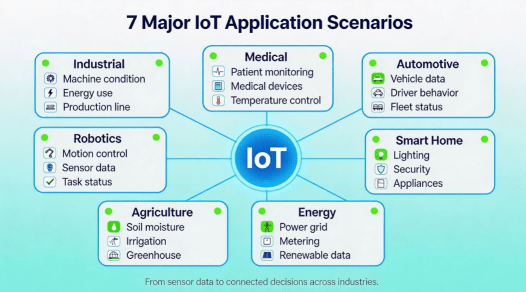
7 Major Iot Application Scenarios
Once the IoT concept is translated into a physical product, the electronic architecture needs a reliable hardware platform.
This is where PCB and PCBA become fundamental.
A typical IoT PCBA may integrate:
The PCB provides the electrical and mechanical foundation, while PCBA converts the design into a functioning electronic assembly.
For this reason, IoT hardware performance is influenced not only by component selection but also by PCB layout, assembly quality, soldering consistency, thermal behavior, signal integrity, power integrity, and manufacturing process control.
Many IoT products operate from batteries or constrained power supplies.
Poor power distribution can cause:
Power architecture should therefore be considered from the beginning of PCB design.
High-speed interfaces and RF systems can be sensitive to:
For wireless IoT products, PCB layout can also influence RF performance.
A module may perform correctly during early testing but behave differently after production if the PCB implementation, grounding, component placement, or assembly consistency is not properly controlled.
IoT devices may contain processors, power converters, RF components, LEDs, sensors, and other heat-generating devices.
Even relatively small products can experience localized thermal problems.
PCB copper distribution, thermal vias, component placement, enclosure design, and operating conditions should therefore be evaluated together.
Many IoT products need to fit into:
Miniaturization increases the importance of:
This is where prototype success must be converted into repeatable manufacturing performance.
An IoT prototype can work perfectly and still encounter problems during volume production.
The reason is simple:
A working prototype is not the same as a repeatable manufacturing process.
As production volume increases, small variations in:
can become significant.
A robust PCBA process therefore needs to control not only the final product, but also the evidence behind the product.
For an IoT project moving from prototype to mass production, a supplier evaluation should go beyond the quoted assembly price.
| Requirement | What the Buyer Should Check |
|---|---|
| Prototype | DFM review and engineering feedback |
| Components | BOM control and traceability |
| SMT | SPI and AOI capability |
| BGA/QFN | X-ray inspection where applicable |
| RF/High Speed | Layout and manufacturing capability |
| Testing | ICT/FCT or customer-defined testing |
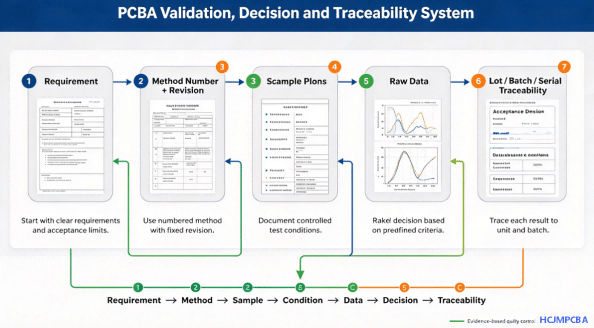
| Documentation | Method number and revision |
| Sampling | Defined sample plan |
| Test Control | Defined test conditions |
| Data | Raw data where applicable |
| Traceability | Lot/batch/serial information |
| Production | Controlled transition from prototype to MP |
This approach helps answer a more important question:
Can the supplier reproduce the required performance consistently at production scale?
For IoT PCBA projects, the manufacturing process needs to translate engineering requirements into controlled production steps.
At HCJMPCBA, the process can be organized around a basic engineering-to-production flow:
Engineering Requirements
↓
BOM / Gerber / Pick-and-Place / Drawings Review
↓
DFM Review
↓
Engineering Confirmation
↓
Component and Material Control
↓
SMT / THT Assembly
↓
SPI / AOI / X-Ray Where Applicable
↓
Electrical / Functional Testing
↓
Traceability
↓
Final Inspection
↓
Shipment
The objective is not simply to assemble components onto a PCB. It is to create a repeatable manufacturing process that can be reviewed, verified, and improved.
For projects requiring stronger documentation, HCJMPCBA can organize production evidence around items such as method number + revision, sample plan, defined test conditions, raw data, and lot/batch/serial traceability, depending on the customer’s requirements and agreed quality plan.
This distinction can be particularly useful when an IoT product moves from engineering samples into sustained volume production.
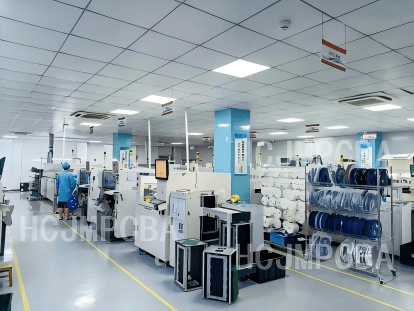
Hcjmpcba Smt
A procurement team does not always need every possible quality document. However, for projects with higher reliability or traceability requirements, several types of evidence are particularly useful.
The production or test method should identify:
This prevents an ambiguous statement such as “tested according to our standard” from becoming the only evidence available.
The buyer should understand:
The appropriate sampling approach depends on the product, customer requirements, risk level, and agreed quality plan.
A test result becomes more useful when the conditions are known.
Depending on the test, this may include:
A simple “PASS” without context may not provide enough information for engineering analysis.
Where applicable, raw test data can help engineers distinguish between:
“The unit passed.”
and
“The unit passed under defined conditions, and the measured result can be reviewed.”
Raw data requirements should be agreed according to the customer’s quality documentation needs.
A mature traceability system can establish a relationship such as:
Customer Order → Production Lot → PCB Lot → Component Lot → PCBA Serial Number → Process Record → Test Record
This becomes especially valuable when investigating field issues or performing corrective actions.
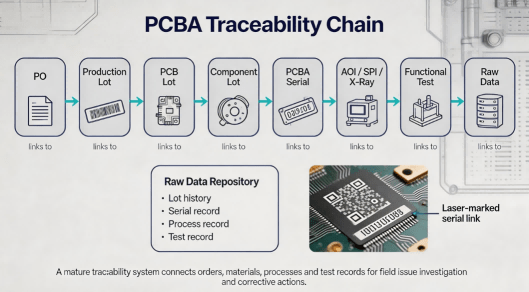
Pcba Traceability Chain
| Verification Area | Example Evidence |
|---|---|
| PCB fabrication | PCB specification / inspection record |
| Components | BOM and lot information |
| SMT process | SPI / AOI records |
| BGA/QFN | X-ray records where applicable |
| Electrical testing | ICT/FCT results |
| Functional testing | Defined test results |
| Engineering control | Method number + revision |
| Sampling | Sample plan |
| Testing | Test conditions |
| Data | Raw data where applicable |
| Traceability | Lot / batch / serial |
The exact evidence package should always be aligned with the customer’s product requirements, quality agreement, applicable standards, and production plan.
The PCBA supplier shall maintain documented production and test controls for IoT hardware, including applicable method number and revision, defined sample plans, test conditions, raw test data where applicable, and traceability to lot, batch, or serial number. Records shall be maintained according to the agreed quality requirements and made available for verification where applicable.
This type of clause can help engineering and procurement teams establish clearer expectations before production begins.
Adding Wi-Fi or cellular connectivity does not automatically solve the system architecture problem.
Sensors, processing, power, security, communication, software, and application requirements should be considered together.
Changing the wireless architecture after PCB layout and mechanical design have been completed can create significant redesign work.
Connectivity should therefore be considered during the early architecture stage.
A powerful processor or wireless module may provide excellent performance but create unacceptable battery consumption.
Power budgeting should begin before the PCB is finalized.
A design may be electrically correct but difficult to manufacture or test.
DFM and DFT considerations can help identify problems before volume production.
A lower assembly price does not necessarily mean lower total cost.
Unexpected rework, component substitutions, unstable processes, inadequate documentation, or poor traceability can create much higher downstream costs.
The better question is:
What is the total manufacturing and quality risk associated with the supplier?
Consider an engineering team developing a wireless industrial temperature-monitoring device.
The prototype contains:
The prototype works successfully.
The engineering team then moves to production—and discovers that some units have inconsistent wireless performance.
The problem may not be the wireless module itself.
Potential contributors could include:
This illustrates an important principle:
IoT development does not end when the prototype works. The real manufacturing challenge is making the same design perform consistently across production units.
That is why PCB design, PCBA process control, testing, documentation, and traceability need to be considered together.
Before moving from prototype to mass production, an engineering or procurement team can consider requesting:
The exact list should be adjusted to the complexity and risk profile of the IoT product.
What constitutes IoT?
IoT generally consists of identifiable physical or virtual things that can communicate and interact through interoperable information and communication technologies, supported by capabilities such as sensing, data capture, processing, and communication. The resulting system provides information or services to an application.
What does IoT mean?
IoT means Internet of Things. It refers to interconnected physical or virtual things that can exchange information through communication technologies and participate in services or applications.
What is the full form of IoT?
IoT stands for Internet of Things.
What is IoT technology?
IoT technology is not a single technology. It is a combination of hardware, sensors, processors, connectivity, software, data processing, and applications used to connect physical or virtual things and exchange or use information.
Is every Internet-connected device an IoT device?
Not necessarily. Internet connectivity is one element of many IoT systems, but a practical IoT system also involves identifiable things, information exchange, sensing or data capture, processing, applications, and appropriate system integration.
What are the main components of an IoT system?
A typical IoT implementation includes a physical or virtual thing, sensors or data acquisition, processing, connectivity, edge or cloud infrastructure, applications, and supporting security/interoperability mechanisms.
What role does PCB play in IoT?
The PCB provides the physical electrical platform that connects and supports components such as sensors, MCUs, memory, power-management circuits, communication modules, and interfaces. PCB design directly influences electrical, thermal, RF, and manufacturing performance.
Why is PCBA manufacturing important for IoT devices?
Because the prototype needs to become a repeatable production product. PCBA manufacturing controls component placement, soldering, inspection, testing, process consistency, and traceability. These factors can influence whether an IoT design performs consistently across production units.
So, what constitutes IoT?
The simplest answer is not merely “a device connected to the Internet.”
A practical IoT system connects things, sensing, processing, communication, data, and applications so that information from the physical or virtual world can be captured and transformed into useful services or actions.
International standards reinforce this broader view. ITU defines IoT around interconnected physical and virtual things and capabilities such as identification, data capture, processing, and communication, while ISO/IEC 30141:2024 provides a standardized reference architecture for IoT systems.
For hardware developers, the concept eventually becomes physical.
Sensors need a circuit.
Processors need power and signal paths.
Wireless modules need an appropriate PCB implementation.
And the complete electronic design needs to be manufactured consistently.
That is where PCB and PCBA become an important part of the IoT value chain.
For OEM teams moving from prototype development to volume production, the manufacturing partner should therefore be evaluated not only by assembly price, but also by engineering support, process capability, inspection, testing, documentation, and traceability.
For more information about PCBA services, please contact Guangzhou Huachuang Precision Technology(HCJMPCBA).
Update triggers: standard revision changes / recurring questions / production checklist updates.
Sources for technical reference
Automated Optical Inspection (aoi inspection pcb) is a non-contact, high-speed quality control metho
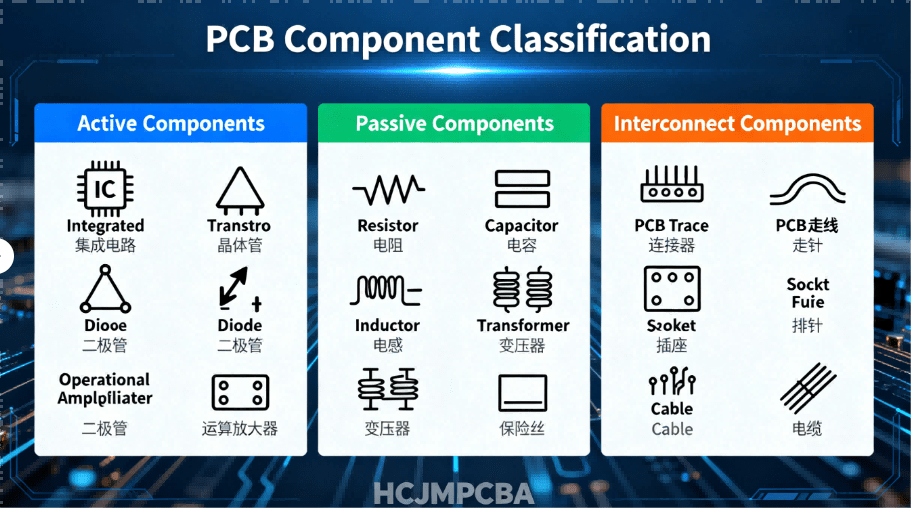
Introduction – Why Circuit Board Components Define PCB Performance & Supply Chain Value A bare
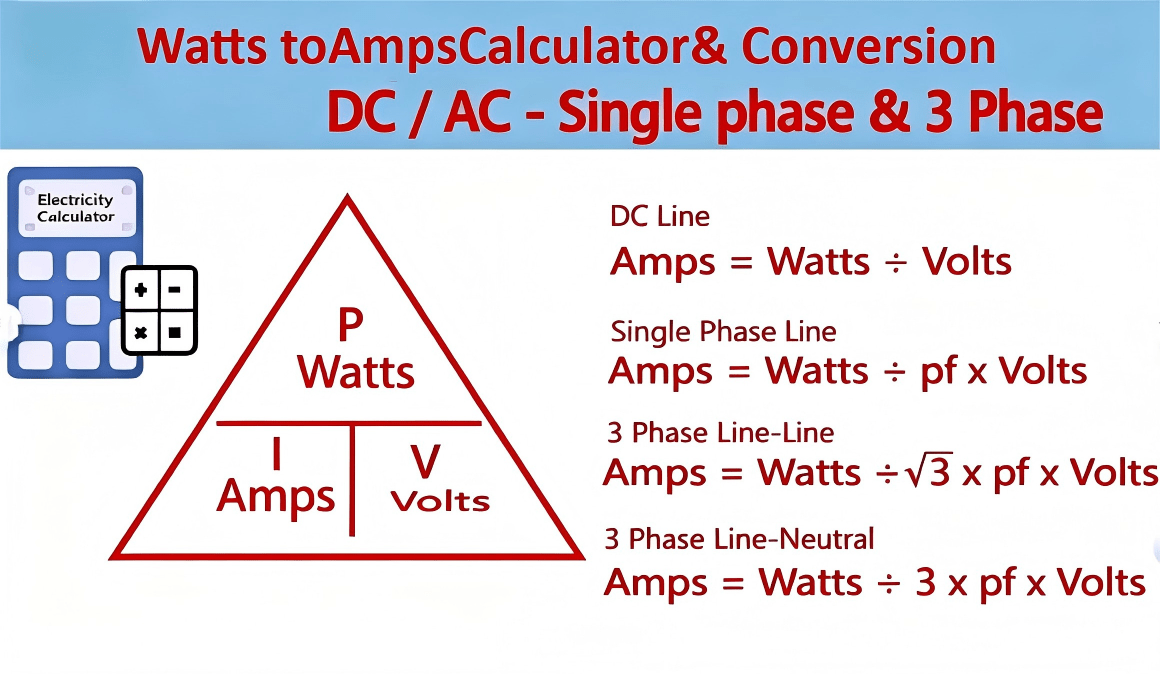
Learn exactly how to convert watts to amps in DC, single-phase AC, and three-phase systems with clea