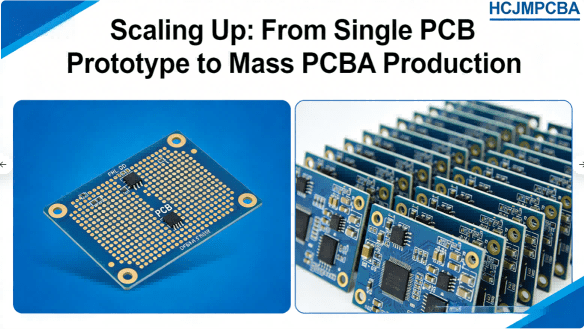
Prototype to Profits: The Ultimate NPI Guide for Mass Production PCBA (2026 Edition)
Quick Answer: What is the NPI Process? The NPI process (New Product Introduction) is the engineering

A Bill of Materials (BOM) is the master document that defines every component, material, and assembly item required to manufacture a product. In PCB and PCBA manufacturing, a well-structured BOM serves as the foundation for sourcing, assembly, quality control, traceability, and revision management, helping reduce manufacturing risk while improving production consistency.
This guide is maintained by the HCJMPCBA engineering team and updated with production checklists.
1. A BOM Is More Than a Parts List
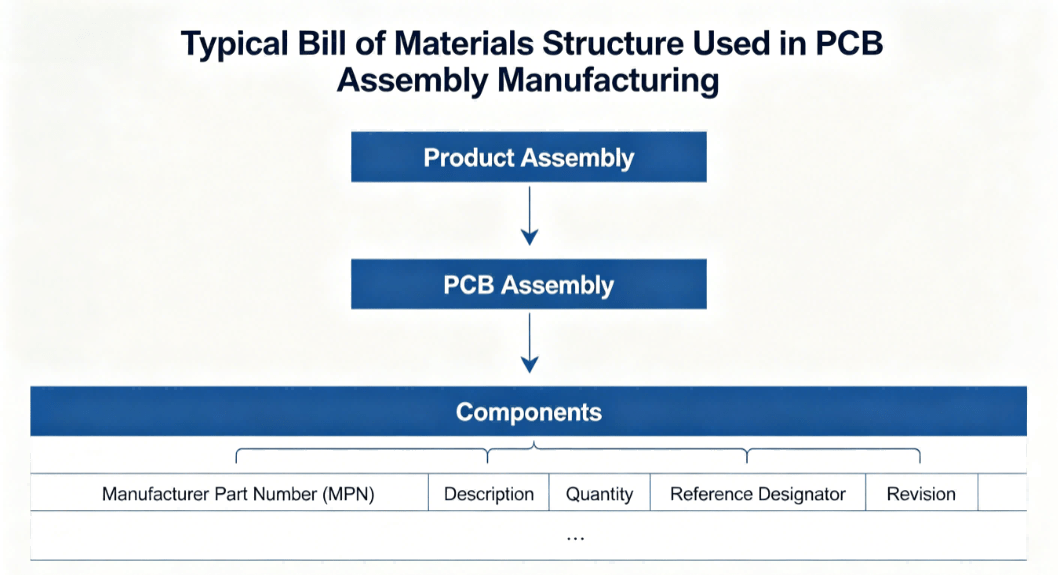
A professional BOM includes manufacturer part numbers, quantities, reference designators, approved alternatives, revision information, and sourcing requirements.
2. BOM Quality Directly Impacts Manufacturing Success
Incomplete or inaccurate BOMs are among the most common causes of procurement delays, production stoppages, and assembly errors.
3. Revision Control Reduces Production Risk
Controlled BOM revisions help prevent incorrect component purchases, outdated documentation, and costly rework during PCB assembly.
A Bill of Materials (BOM), sometimes called a bill of material, build of materials, or engineering bill of material, is a structured document that lists every item required to manufacture a finished product.
In electronics manufacturing, the BOM acts as the single source of truth for engineering, procurement, production, and quality teams.
A typical BOM identifies:
Without an accurate BOM, even the most advanced PCB design can encounter sourcing issues, assembly mistakes, or production delays.
In PCB and PCBA projects, the BOM is closely tied to:
For this reason, BOM accuracy is often one of the most important factors influencing production quality and delivery performance.
Typical Bill Of Materials Structure Used In Pcb Assembly Manufacturing Hcjmpcba
Many production problems can be traced back to BOM issues rather than manufacturing defects.
A properly managed BOM improves:
Assembly operators and automated equipment rely on BOM data to ensure the correct components are installed.
Purchasing teams use BOM information to source components accurately and efficiently.
Accurate BOMs help avoid excess inventory, shortages, and unnecessary procurement costs.
Many industries require traceability from raw materials to finished products.
A structured BOM supports:
As products become increasingly complex, BOM management becomes a critical part of risk reduction.
Different manufacturing stages often require different BOM structures.
| BOM Type | Purpose | Primary Owner |
|---|---|---|
| Engineering BOM (EBOM) | Product Design | Engineering Team |
| Manufacturing BOM (MBOM) | Production | Manufacturing Team |
| Service BOM | Maintenance and Repair | Service Team |
| Configurable BOM | Product Variants | Product Management |
The Engineering BOM originates from the design environment and reflects the engineer’s intended product structure.
The Manufacturing BOM contains the information required for actual production, including assembly-specific requirements and approved alternatives.
For PCBA projects, MBOMs are often used to coordinate procurement and manufacturing execution.
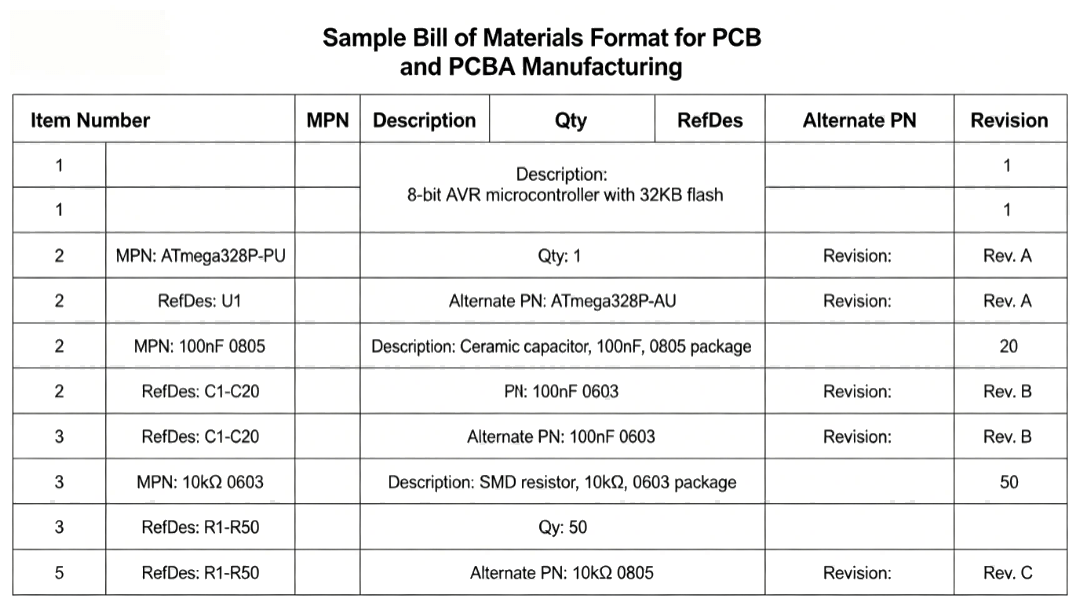
A professional electronic BOM should include the following fields.
The most important identifier for procurement and verification.
A standardized description helps reduce ambiguity.
Defines the number of components required per assembly.
Identifies the exact PCB locations where components are installed.
Indicates whether a component is active, obsolete, or approaching end-of-life (EOL).
Helps mitigate supply chain disruptions.
Supports engineering change management.
May include RoHS, REACH, UL, or customer-specific requirements.
Provides sourcing guidance and purchasing restrictions.
Sample Bill Of Materials Format For Pcb And Pcba Manufacturing Hcjmpcba
Every BOM should begin with a clearly defined product revision.
Using uncontrolled revisions can lead to procurement errors and production delays.
Extract component information directly from CAD software whenever possible.
This reduces manual entry errors.
Ensure all reference designators match the schematic and PCB layout.
Use consistent naming conventions to improve sourcing and communication.
Avoid relying solely on distributor stock numbers.
Manufacturer part numbers provide greater sourcing flexibility.
Supply chain disruptions are common.
Approved alternatives can significantly reduce procurement risk.
Verify:
Components nearing end-of-life should be reviewed before production release.
Confirm that component quantities align with design files and assembly requirements.
Engineering, procurement, quality, and manufacturing teams should review the BOM together.
Once approved, the BOM should be formally released and controlled.
Determine what records will be maintained throughout production.
At HCJMPCBA, BOM review activities may include sourcing verification, manufacturability assessment, revision validation, and production readiness checks before procurement begins.
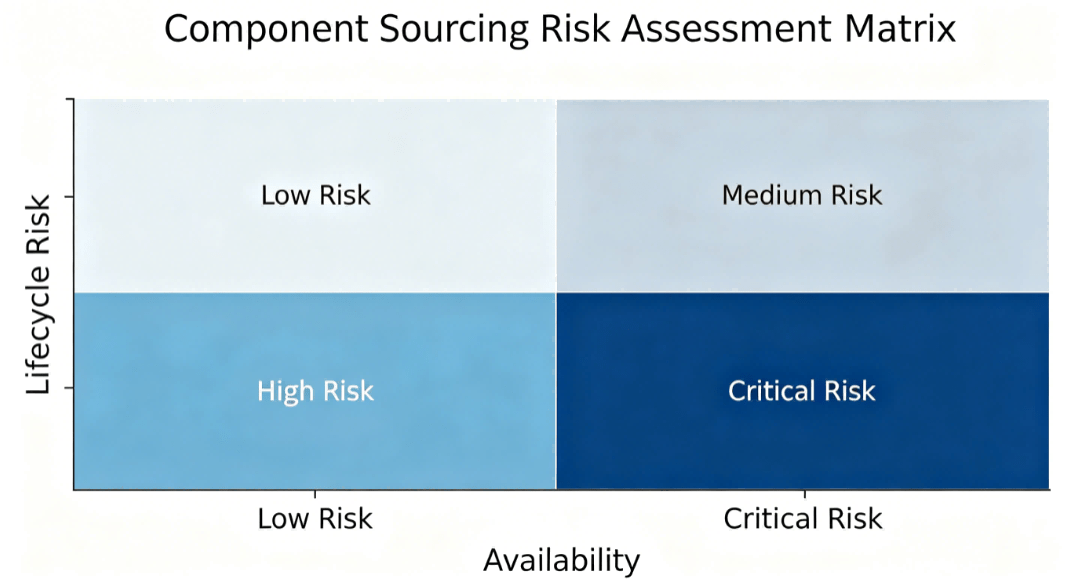
Many BOM-related problems originate in the supply chain.
A good BOM strategy should address sourcing risk proactively.
Using approved suppliers helps improve consistency and reduce counterfeit risk.
Parts approaching end-of-life should be identified early.
Approved alternatives provide flexibility when shortages occur.
Critical parts with extended lead times should be identified during BOM review.
Verification procedures help reduce the risk of counterfeit or unauthorized components entering the supply chain.
For many OEMs, BOM sourcing is just as important as PCB assembly itself.
Component Sourcing Risk Assessment Matrix Hcjmpcba
| Project Type | Recommended BOM |
| Prototype | Simplified EBOM |
| NPI Build | Detailed EBOM |
| Low-Volume Production | Controlled MBOM |
| High-Volume Production | Full MBOM with AVL |
| Regulated Products | Full Traceable BOM |
| Verification Item | Evidence |
| MPN Accuracy | Engineering Review |
| Quantity Validation | BOM Audit |
| Lifecycle Assessment | Supply Chain Review |
| Revision Control | Revision History |
| Sample Plan | Inspection Records |
| Test Conditions | Qualification Reports |
| Traceability | Lot / Batch / Serial Records |
| Raw Data | ERP or MES Records |
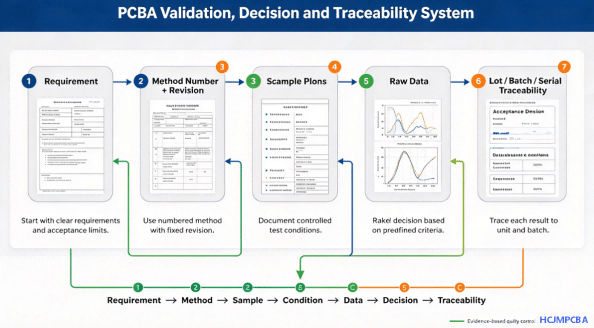
For controlled PCB and PCBA projects, HCJMPCBA can maintain manufacturing documentation associated with method numbers, revision histories, inspection plans, sourcing reviews, and production traceability requirements when specified by customer agreements.
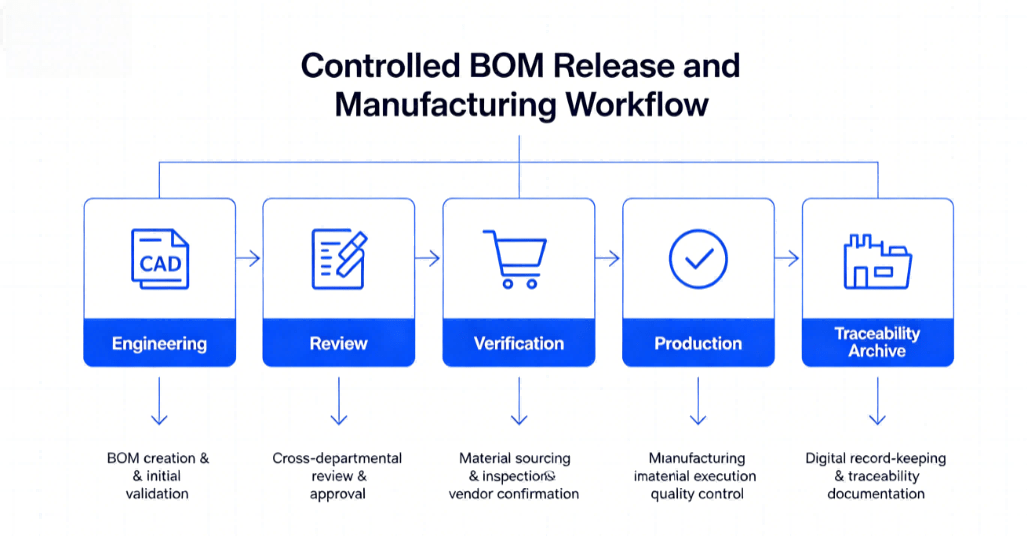
Controlled Bom Release And Manufacturing Workflow Hcjmpcba
Mistake 1 – Missing Manufacturer Part Numbers
Without MPNs, sourcing becomes inconsistent and error-prone.
Mistake 2 – Using Distributor SKUs Instead of MPNs
Distributor inventory changes frequently.
MPNs provide better long-term control.
Mistake 3 – Omitting Approved Alternatives
This can create unnecessary procurement delays.
Mistake 4 – Releasing Outdated BOM Revisions
Revision confusion remains one of the most common causes of manufacturing errors.
Mistake 5 – Ignoring Lifecycle Status
An obsolete component can halt an entire production schedule.
An OEM preparing for a low-volume production run accidentally released an outdated BOM revision.
Several components listed in the old BOM had already been replaced during engineering validation.
Procurement purchased the obsolete components, resulting in:
After implementing formal revision control procedures and approval workflows, subsequent production runs proceeded without BOM-related delays.
The lesson was simple: BOM management is a manufacturing process, not merely a documentation task.
OEM buyers evaluating a PCB assembly supplier may request:
These records provide objective evidence that the supplier operates under controlled manufacturing processes.
Supplier shall maintain revision-controlled bill of materials documentation, approved component sourcing records, traceability information, and supporting verification evidence for applicable production lots. Records shall be retained according to agreed project requirements and made available upon request.
What is a bill of materials?
A bill of materials is a structured list of all components and materials required to manufacture a product.
What is BOM in manufacturing?
A BOM serves as the primary manufacturing reference for procurement, production, and quality control activities.
What is the difference between an EBOM and an MBOM?
An EBOM reflects the engineering design, while an MBOM contains information required for manufacturing and assembly.
How do you create a bill of materials?
Start with design data, verify component information, define approved alternatives, validate quantities, and establish revision control.
What information should a BOM contain?
A BOM should include MPNs, descriptions, quantities, reference designators, revisions, compliance requirements, and sourcing information.
Why are alternate components important?
They help reduce supply chain risk and improve procurement flexibility.
How is BOM accuracy verified?
Through engineering review, sourcing validation, cross-functional audits, and revision control procedures.
What BOM records should a PCBA supplier provide?
Typical records include revision histories, traceability data, sourcing documentation, inspection records, and production verification reports.
A Bill of Materials (BOM) is far more than a component list. It serves as the foundation for procurement, manufacturing, quality control, traceability, and product lifecycle management.
An accurate BOM helps reduce sourcing risk, improve manufacturing consistency, prevent costly revision errors, and support long-term product reliability.
For OEMs, engineers, and procurement teams, evaluating a supplier’s BOM management capability can be just as important as evaluating assembly equipment or production capacity. Strong BOM discipline often translates directly into smoother production launches and more predictable manufacturing outcomes.
For more information about PCBA services, please contact Guangzhou Huachuang Precision Technology (HCJMPCBA).
Update triggers: standard revision changes / recurring questions / production checklist updates.
Quick Answer: What is the NPI Process? The NPI process (New Product Introduction) is the engineering
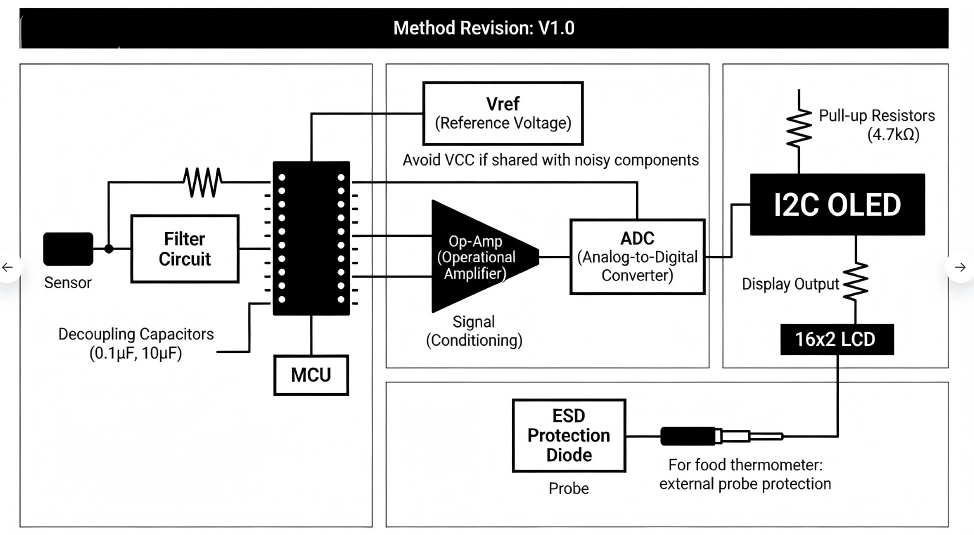
Looking for a professional digital thermometer circuit diagram or a precise thermometer drawing for
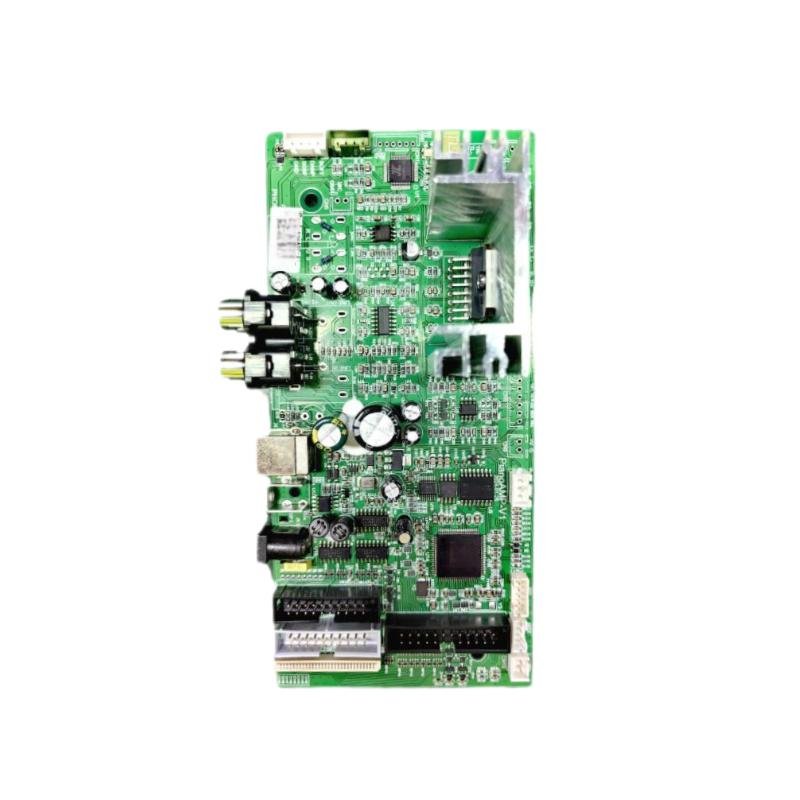
Discover HCJMPCBA’s 13485 medical manufacturing excellence in medical PCB assembly. Learn about me