Exploring PCBA Technology: The Core of Electronic Manufacturing at Guangzhou Huachuang Precision Technology Co., Ltd.
This article provides an in-depth exploration of PCBA technology, its evolution, key processes, chal

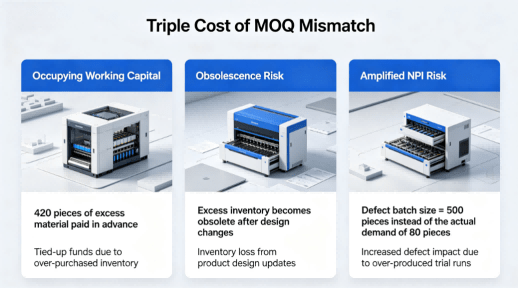
If you have ever received a quote with a 500-piece minimum order quantity for a build you only need 80 units of, you know the conversation that follows internally: does the team eat the cost of 420 extra boards, or does the program timeline slip while procurement goes back to negotiate? Neither answer is good.
The root problem is not your volume. It is that you are quoting the wrong type of supplier.
On paper, an MOQ overage looks like a simple inventory line item. In practice, it compounds across three separate cost centers.
Working capital. Components for the extra 420 units are purchased and paid for up front, even though there is no forecasted demand for them. For a startup or a program still validating market fit, that is capital that is not available for the next design cycle.
Obsolescence risk. HMLV programs — by definition — iterate. A board revision, a component substitution, or a firmware-driven BOM change can render surplus inventory unusable well before it is ever built. Excess stock is not a cushion; it is a liability with an expiration date nobody can predict.
Exposure scaling during NPI. If a defect surfaces during first-article inspection or early production — a marginal solder joint, a reflow profile issue — the size of the affected lot determines the size of the loss. A 500-unit MOQ does not just mean more inventory risk; it means any process escape hits five times more product than your actual demand required.
Schematic Diagram Of Threefold Costs Caused By Mismatched Moq Hcjmpcba
It is worth understanding the logic before assuming it is arbitrary — because that logic reveals which suppliers are structurally incapable of solving this problem for you.
Large-scale EMS providers built their cost models around three assumptions: changeover costs need to be amortized across long runs, line utilization needs to stay high to justify capital equipment, and material pricing depends on purchasing at volume-discount tiers.
Every one of those assumptions works against a buyer who needs 50, 150, or 300 units. The MOQ is not a policy decision — it is a mathematical consequence of how the factory is built to operate. Asking a high-volume line to run a low-volume batch does not just cost more; it actively disrupts the throughput the whole facility is optimized around.
MOQ is not a negotiating position. It is a structural property of the supplier’s line design and pricing model. You cannot negotiate your way out of physics.
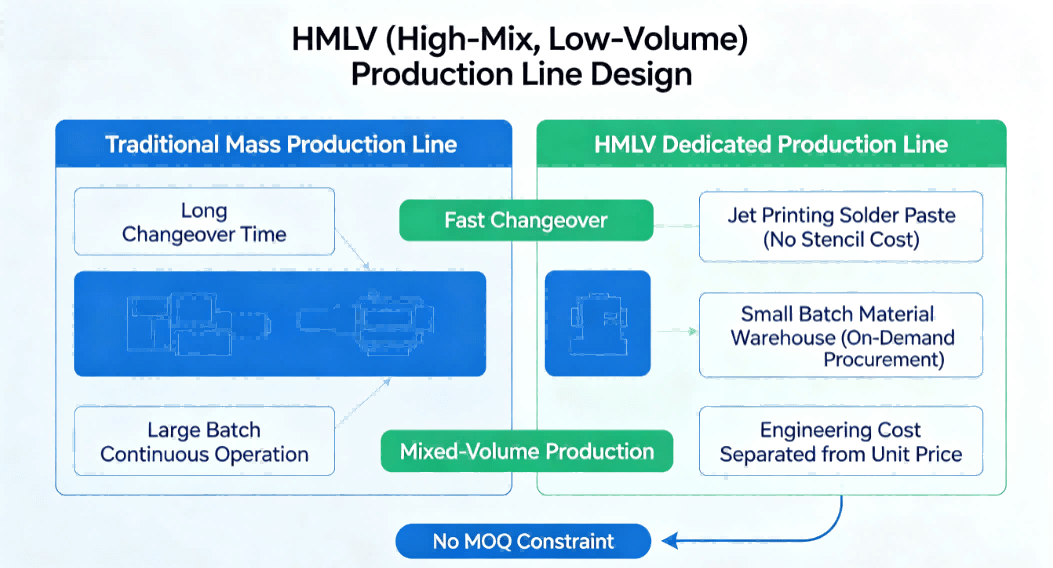
Suppliers built specifically for high-mix, low-volume production solve this at the architecture level, not the quote level.
Line design for frequent changeover. Jet-printing SMT platforms, for example, replace stencil-based paste deposition — eliminating the changeover cost and lead time that stencils impose between job runs. That single equipment decision is what allows a line to pivot between a 60-unit medical job and a 200-unit industrial job in the same shift without a changeover penalty.
Material procurement built for variability. Rather than relying on bulk-purchase discounts, HMLV-focused suppliers use framework agreements with distributors and maintain calibrated safety stock across common component families. This decouples unit pricing from order volume.
Pricing models that separate engineering cost from unit price. Instead of amortizing NRE across a large run — which is what forces a high MOQ to make the math work — HMLV pricing front-loads engineering and process-preparation costs as a distinct line item, leaving the unit price genuinely reflective of your actual volume.
At Guangzhou Huachuang Precision Technology Co., Ltd. (HCJMPCBA), we have built our manufacturing operation around these principles. Our nearly 3,500 m² ESD‑protected facility, multiple high-speed SMT lines, and ISO9001 and ISO13485 certifications provide the foundation for reliable HMLV PCBA — from prototypes to low-volume production runs. But capacity alone is not the solution. Our production planning is structured for frequent changeovers, our procurement model is calibrated for variable order sizes, and our pricing transparently separates NRE from unit cost — so you are not forced to buy more than you need to make the economics work.
Schematic Diagram Of Dedicated Hmlv Production Line Design Hcjmpcba
Plenty of suppliers will claim HMLV capability during the sales cycle. Here is how to verify it during RFQ, before you are committed.
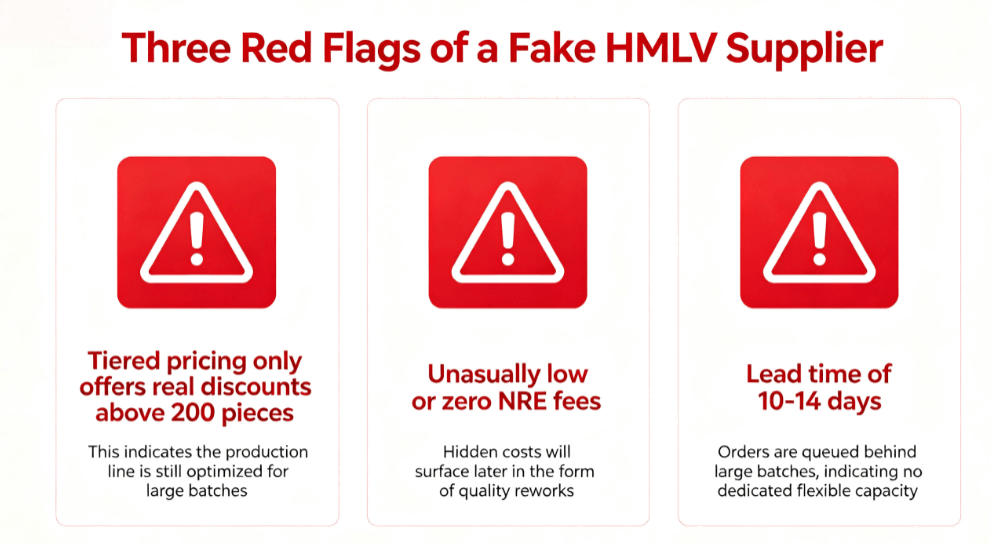
Signal one: tiered pricing that still bottoms out at a 200-plus unit minimum. If the “discount” only kicks in above that floor, the line is still volume-optimized — “low volume” is relative to their normal run size, not yours.
Signal two: an unusually low or waived NRE fee. This typically means no real first-article process preparation is being done; the cost has not been eliminated, it has been hidden, and it tends to resurface later as quality escapes or rework.
Signal three: a quoted lead time of 10 to 14 days. A genuine HMLV line should be able to quote 5 to 8 days; anything longer usually means your job is being queued behind larger production runs rather than run on dedicated flexible capacity.
If a supplier shows even one of these signals, treat the “no MOQ” claim as unverified.
Three Warning Signs Of Fraudulent Hmlv Suppliers Hcjmpcba
The most common reason procurement teams get penalized on price is not volume — it is how the requirement is framed. If your RFQ reads like a standard order request, you will be quoted against standard order economics.
State explicitly, in the RFQ itself, that this is an HMLV program requiring frequent changeover capability, not a one-time small-batch exception.
Ask directly: What is your standard changeover time between job types on the line that would run this build? What percentage of your current production mix is under 300 units?
If a supplier’s answer to “your volume is too small” is generic, push back with a specific question: Is this a pricing constraint, a line-scheduling constraint, or a capability gap? Each answer points to a different — and disqualifying — root cause.
At HCJMPCBA, we welcome these questions. Our production planning is transparent: we publish standard changeover protocols, we track mix ratios, and we quote based on actual line capacity — not on a formula that assumes you will buy more than you need. Our production capacity supports volumes from pilot runs of a few dozen boards to mass production of tens of thousands per month, with consistent process discipline across every batch — but we never force a customer to order beyond their actual requirement to make the unit price work.
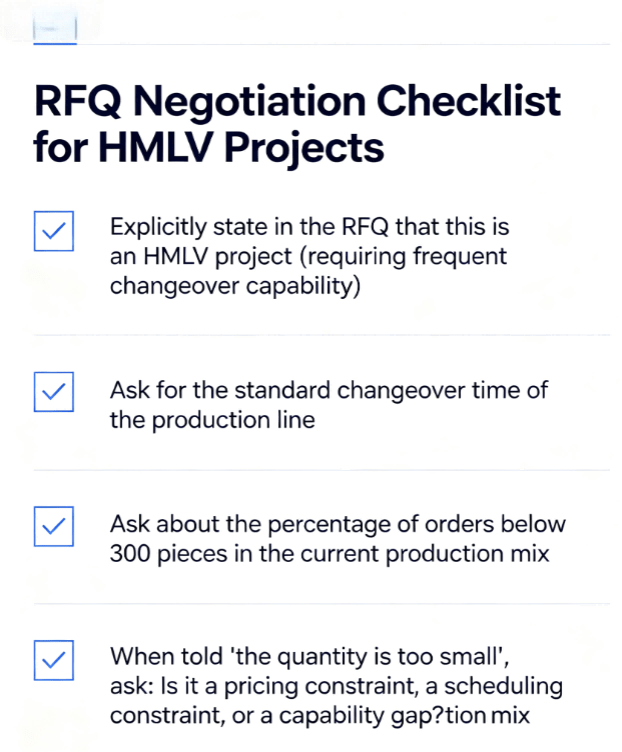
Hcjmpcba Rfq Negotiation Checklist
HMLV is not a niche capability that can be retrofitted onto a high-volume line. It is a fundamentally different way of building electronics — one that requires deliberate choices in equipment, procurement, and pricing.
Equipment choices matter. A line that runs 50-unit batches every day cannot afford a 45-minute stencil changeover between jobs. Jet-printing paste deposition, rapid placement program loading, and flexible reflow profiling are not optional — they are the baseline.
Procurement choices matter. Buying components for a 75-unit run at volume-discount prices is not possible. The alternative is not to accept higher component costs — it is to build a procurement model that uses framework agreements, consignment stock, and component pooling to keep unit costs competitive without requiring bulk purchases.
Pricing choices matter. The cost of engineering, programming, and first-article inspection is real whether you build 50 boards or 5,000. The only honest way to price HMLV is to separate that cost from the unit price — so you pay for the engineering once, and you pay for the boards you actually need.
This is the model HCJMPCBA has implemented across our nearly 3,500 m² facility. Our engineering team provides upfront process parameter recommendations and production readiness reviews before your first board enters the line — so you get the same level of preparation as a high-volume run, without the volume penalty.
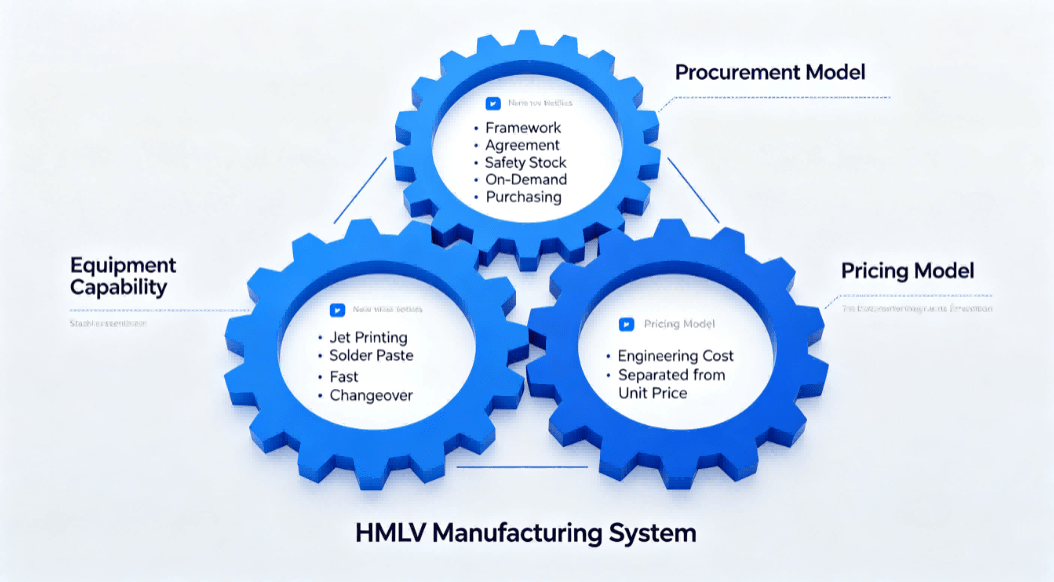
Three Core Capabilities Of Hmlv Manufacturing Hcjmpcba
The problem is not that your volume is too low. The problem is that you are asking a high-volume supplier to run a low-volume job — and their economics make that impossible without imposing a punishing MOQ.
The solution is to find a supplier whose economics are built for your volume from the ground up. A supplier whose line design, procurement model, and pricing structure are calibrated for 50-unit and 200-unit batches — not retrofitted from a million-unit baseline.
HCJMPCBA is that supplier. With nearly 3,500 m² of ESD‑protected manufacturing space, multiple high-speed SMT lines, ISO9001 and ISO13485 certifications, and a production model engineered for HMLV, we deliver the quality and reliability you need — without forcing you to buy boards you do not want.
Ready to get a quote that reflects your actual volume? Contact our team with your BOM and Gerber files — we will show you what HMLV pricing looks like when the supplier is built for it.
Guangzhou Huachuang Precision Technology Co., Ltd. (HCJMPCBA) — HMLV PCBA, built for your volume, not ours.
This article provides an in-depth exploration of PCBA technology, its evolution, key processes, chal
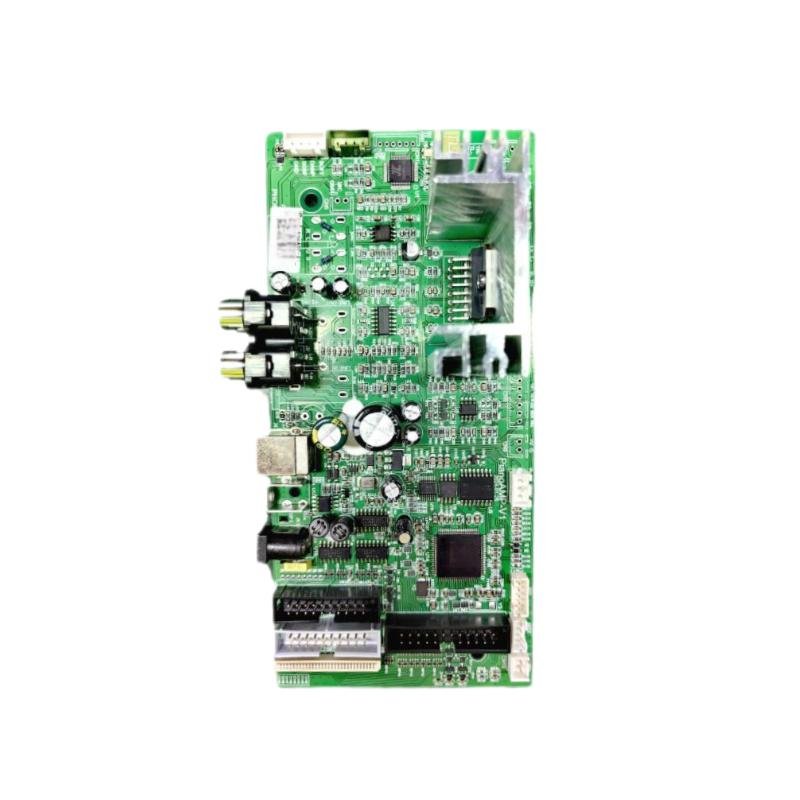
Discover HCJMPCBA’s 13485 medical manufacturing excellence in medical PCB assembly. Learn about me
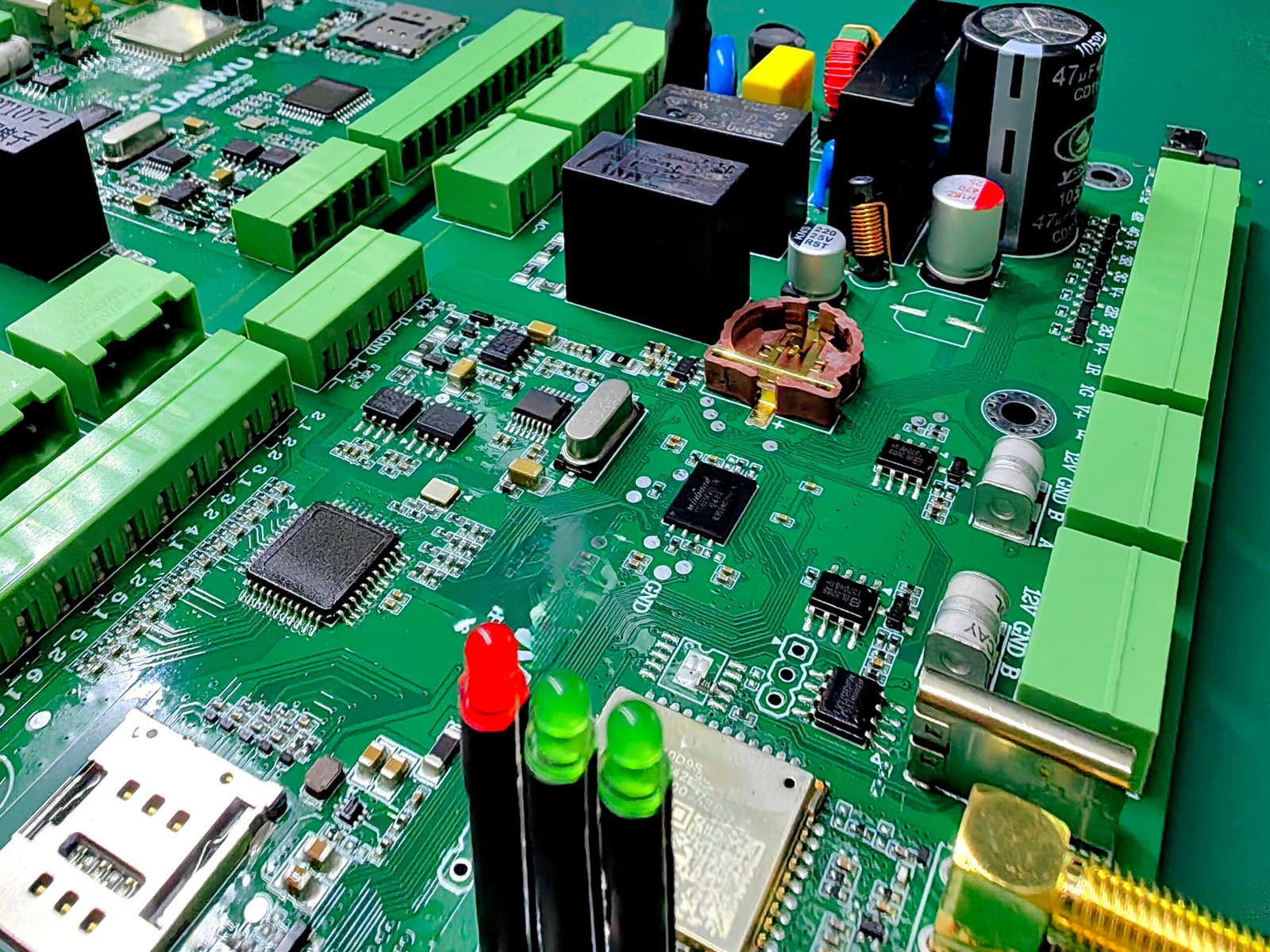
Discover what does PCB stand for in this comprehensive guide by HCJMPCBA. Learn about ict tester rol