8 Critical Insights into What is Hi pot Testing: A Complete Guide with Standards, Methods, and Practical Evidence
A comprehensive guide to hipot testing (high potential/hi-pot/dielectric withstand), explaining what

This guide is maintained by the HCJMPCBA engineering team and updated with production checklists. To define circuits in a professional manufacturing context: a series circuit connects components end-to-end in a single path, meaning the same current flows through all components. While simple, in pcba manufacturing, a series loop requires extreme precision; a single weak solder joint can fail the entire circuit card assembly.
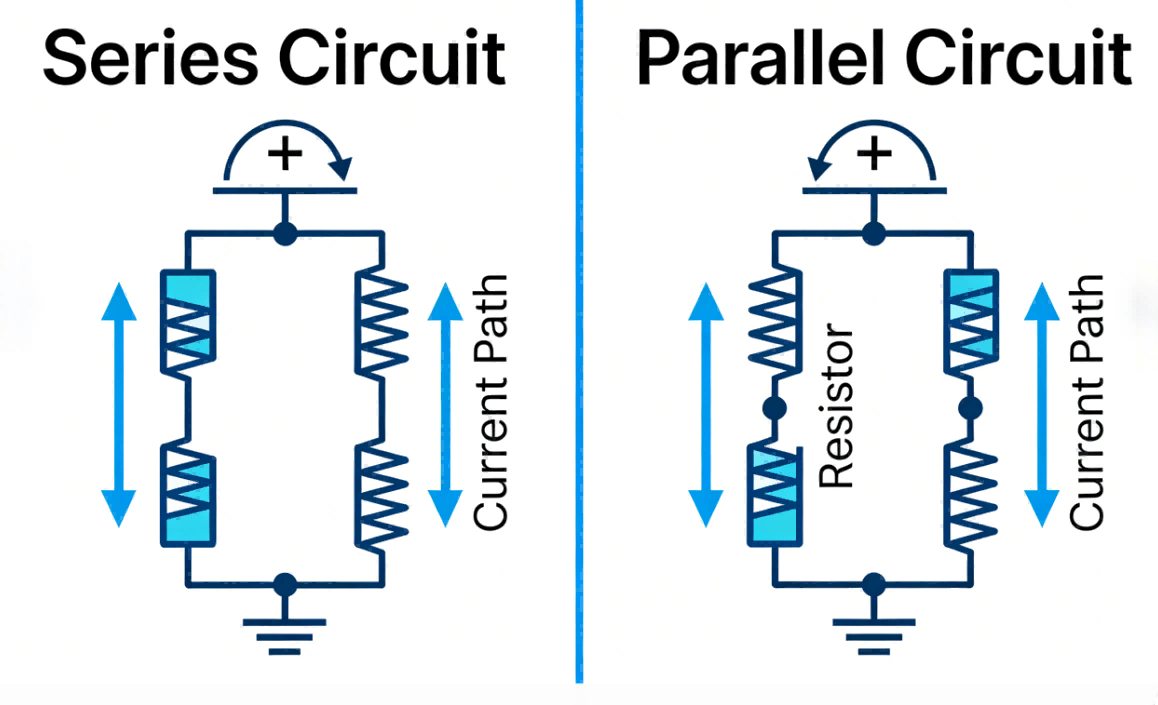
Series Vs Parallel Circuit Diagram Current Voltage Comparison
| Feature | Series Circuit Diagram Logic | Parallel Circuit Circuit Logic | PCBA Design Impact |
|---|---|---|---|
| Current | Same through all components | Divided across branches | Critical for current balancing design |
| Voltage | Divided across components | Equal across all branches | Impacts voltage stability in PCBA |
| Failure Mode | Single failure breaks entire circuit | Partial failure allowed | Parallel preferred for reliability |
| Thermal Load | Distributed | Localized hotspots possible | Requires thermal design optimization |
Define common VCC and GND nodes to establish the parallel circuit architecture.
Calculate total current load across branches to avoid overheating in high-density layouts.
Align components for high-speed SMT placement using Samsung SM481 systems.
Design copper distribution to prevent hotspots in high-power parallel circuits.
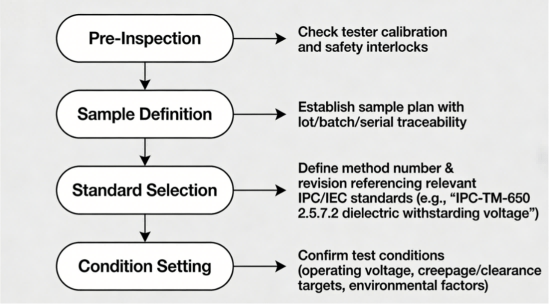
Implement ICT and functional testing based on defined test conditions and sample plans.
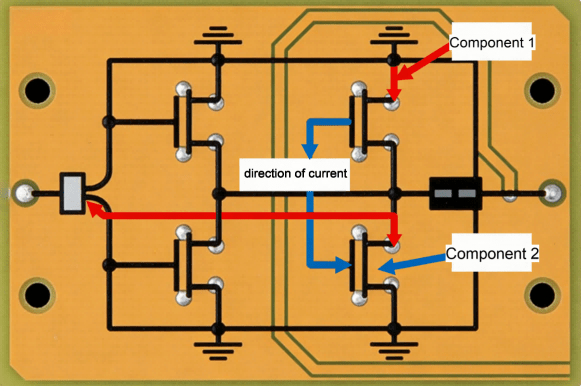
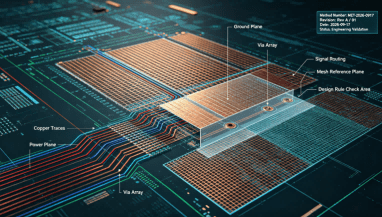
Parallel Circuit Pcb Layout High Current Design
| Metric | Standard (IEC/IPC) | HCJMPCBA Verification Evidence |
|---|---|---|
| Continuity | IEC 61189 | ICT Raw Data Logs |
| Voltage Stability | IPC-9252 | Functional Test Reports |
| Thermal Reliability | IPC-TM-650 | Thermal Cycling Data |
| Traceability | ISO 9001 | Lot/Batch/Serial Tracking |
In a laboratory, a series circuit is just a wire and some resistors. In a factory, it is a high-risk assembly. At HCJMPCBA, we don’t just “assemble” electronic parts; we manage them.
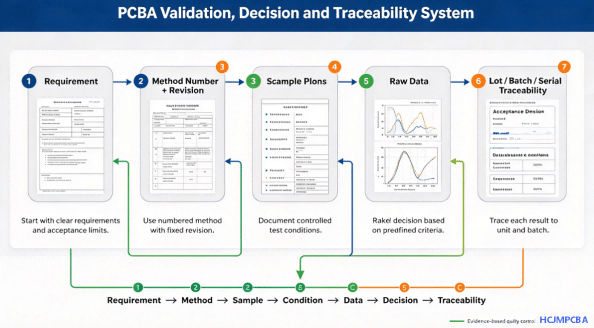
Every series circuit diagram we receive is assigned a unique Method Number + Revision. This ensures that the specific test conditions used for your first prototype are identical to those used in a 100,000-unit mass production run. Whether we are dealing with resistors in series vs parallel, our Samsung SM481 high-speed SMT lines are programmed to verify component values in real-time, preventing the “cascading failure” common in poorly managed series loops.

Pcba Traceability System Method Number Report
All series and parallel circuits must be validated against the approved Method Number + Revision. Production must include raw data logs of electrical test conditions. Full traceability (lot/batch/serial) for all components is mandatory to ensure reliability and compliance.
In a high-volume LED project, HCJMPCBA optimized a parallel circuit circuit configuration to distribute current evenly across thousands of units.
By applying:
Failure rate was reduced from 3.2% to 0.08%, proving the importance of controlled parallel vs series circuit design.
What is the main difference between series and parallel circuits?
In a series circuit, current remains constant but voltage is divided; in parallel circuits, voltage remains constant while current is divided across branches.
Does the criteria are voltage or current in parallel?
The defining criteria for parallel vs series is that in parallel, the voltage across each component is the same, while the total current is the sum of the individual branch currents.
Why does HCJMPCBA require a Sample Plan for series circuits?
Because a single defective component in a circuit in serie breaks the entire system, our Sample Plan ensures 100% electrical testing for critical loops before shipping.
How do you calculate resistors in series vs parallel?
(Provide the standard formula here, but immediately pivot to: “Our engineering team verifies these calculations during the DFM phase to ensure your PCBA yield is optimized.”)
Understanding series and parallel circuits is not just theory—it directly impacts PCBA reliability, thermal performance, and scalability.
At HCJMPCBA, every circuit configuration is controlled through:
This ensures consistent, repeatable, and scalable mass production for global OEM clients.
Update triggers: standard revision changes / recurring questions / production checklist updates.
A comprehensive guide to hipot testing (high potential/hi-pot/dielectric withstand), explaining what
This article provides an in-depth exploration of PCBA technology, its evolution, key processes, chal
Discover pcb board washer methods tailored for HCJMPCBA’s SMT‑built assemblies—from manual bru