What Is PCB Design? — Comprehensive Guide to PCB Design Services
Explore what pcb design services entail—from schematic creation to Gerber file outputs. This compr

The Restriction of Hazardous Substances (RoHS) Directive, first enacted by the European Union to minimize the environmental and health hazards posed by harmful materials in electrical and electronic equipment (EEE), has grown far beyond its European origins. Today, RoHS compliance is a global concern affecting manufacturers, suppliers, OEMs, and PCB assembly providers worldwide.
The most recent version of the regulation — often referred to as RoHS 3 — prohibits ten hazardous substances: lead, mercury, cadmium, hexavalent chromium, PBB, PBDE, and four regulated phthalates (DEHP, BBP, DBP, and DIBP). These restrictions apply at the homogeneous material level, meaning each individual material within a product must independently satisfy the concentration limits.
However, in 2026, RoHS compliance is no longer simply a matter of meeting lab testing criteria. Manufacturers now face tougher exemption policies, expanding international regulations, and greater demands for supply chain transparency. Compliance management has become an integral part of modern electronics manufacturing.
At Guangzhou Huachuang Precision Technology Co., Ltd. (HCJMPCBA), we integrate RoHS 3 compliance into our standard production processes. With nearly 3,500 m² of ESD‑protected manufacturing space, multiple high-speed SMT lines, and ISO9001 quality management and ISO13485 medical device quality management certifications, we ensure that every board we assemble meets applicable restricted substance requirements — from component sourcing to final delivery.
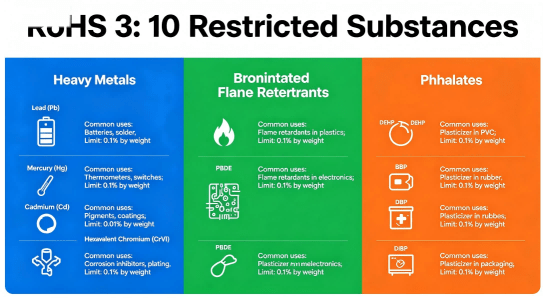
Rohs 3 List Of Ten Restricted Substances
One of the most significant changes in recent years is the ongoing worldwide expansion of RoHS-related regulations. Countries including China, Vietnam, Uzbekistan, and Brazil are tightening their own hazardous substance regulations to meet international environmental standards.
While these regulations are largely based on the EU RoHS framework, there are differences in technical documentation requirements, labeling rules, and conformity assessment procedures. This adds complexity for manufacturers whose products are sold across multiple markets. A product that is compliant in Europe may not automatically satisfy the requirements of other jurisdictions without additional documentation or testing.
Furthermore, RoHS implementation is increasingly linked to other environmental regulations — including REACH, SCIP database reporting, PFAS restrictions, and eco-design programs. Rather than managing these requirements individually, more companies are developing centralized compliance systems that can handle multiple environmental regulations simultaneously. Integrating compliance management is essential for electronics manufacturers to mitigate regulatory risks and ensure market access.
One of the biggest compliance challenges in 2026 is the expiration of long-standing RoHS exemptions. Certain industries have historically been exempt from the lead restriction in specific applications where technically feasible substitutes could not be found — including high-temperature solders, industrial monitoring devices, medical devices, telecommunications infrastructure, and specialized alloy items.
However, advances in lead-free technology have led regulators to reconsider many of these exemptions. Several key exemptions are scheduled to expire from 2026 through 2027, driving a need for product redesign and testing of alternative materials.
Replacing lead-containing materials is often far more complex than simply substituting a single component. Thermal reliability testing, solder joint analysis, PCB redesign evaluations, and durability validation may all be required to ensure that product performance remains stable after transitioning to lead-free materials. Businesses must be mindful of exemption deadlines to ensure timely shipments, product compliance, and market access to regulated regions.
For manufacturers serving medical device and industrial control markets — where many exempt applications have historically been concentrated — proactive exemption tracking has become a critical component of compliance strategy. At HCJMPCBA, we actively monitor exemption expirations that affect our customers’ products, providing timely guidance on material transitions and process adjustments.
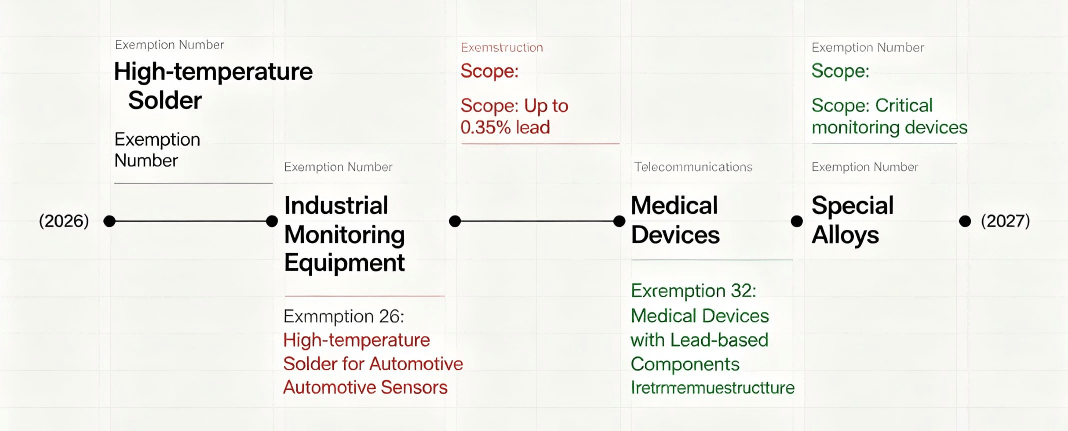
Key Lead Expiry Dateline
Modern electronic products are composed of thousands of component parts sourced from multiple countries. RoHS compliance has become one of the most challenging aspects of electronics manufacturing, particularly within these complex supply chains.
Manufacturers are increasingly requesting suppliers to provide complete material declarations, certificates of compliance, IPC-1752A declarations, safety data sheets, and laboratory testing reports. Most companies have implemented formal change notification processes designed to prevent undocumented material substitutions.
However, supplier data quality remains a significant problem. As the number of changes to reports increases, so does the risk of compliance issues — especially when reporting formats are inconsistent or documentation is incomplete. A single non-compliant part can compromise the compliance status of an entire product assembly.
To minimize these risks, many businesses are turning to automated compliance management systems that can gather supplier information, flag materials that pose risks, and track regulatory updates in real time. Digital traceability systems are also gaining relevance, enabling manufacturers to trace the composition of materials used throughout the product lifecycle and enhance supply chain visibility.
At HCJMPCBA, our intelligent MES system provides full component-level traceability, linking each assembled board to its complete material history — including manufacturer certifications, date codes, and RoHS compliance status. This ensures that every component on every board can be traced back to its source, providing our customers with the documentation they need for regulatory audits and market access.
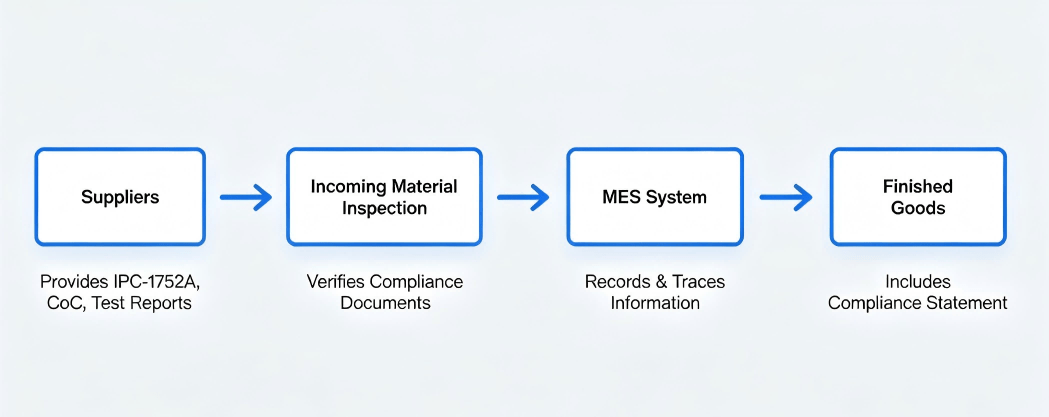
Supply Chain Compliance Information Flow Diagram
While supplier documentation has become increasingly important, laboratory testing continues to play a major role in RoHS verification strategies.
X-ray fluorescence (XRF) screening remains widely used for rapid elemental analysis of metals and electronic assemblies. Gas chromatography-mass spectrometry (GC-MS) is one of the most frequently used techniques for detecting restricted phthalates in plastics and polymer-containing products. For confirmatory testing in more hazardous scenarios, wet chemistry analysis may also be performed.
One of the most important compliance documents is the RoHS Declaration of Conformity (DoC). This document serves as a written declaration of compliance to relevant RoHS requirements and may be required for CE marking and export to foreign markets. Manufacturers are also expected to maintain technical documentation, supplier declarations, test records, exemption justifications, and engineering change documentation as part of their long-term compliance initiatives.
Our testing and documentation approach at HCJMPCBA includes:
Incoming material verification — Components are verified against supplier-provided RoHS documentation before they enter production
Process material control — Solder paste, flux, and other consumables are selected from RoHS-compliant sources
Comprehensive documentation — Each order includes RoHS Declaration of Conformity, test reports (where applicable), and full material traceability records
Audit-ready records — All compliance documentation is maintained within our MES system, available for customer review or regulatory audit at any time
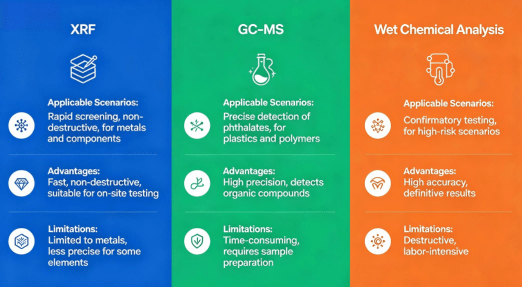
Comparison Chart Of Rohs Compliance Testing Methods
RoHS 3 compliance in 2026 is much more than a process of hazardous substance testing. Today, it represents a full operational responsibility, impacting product design, supplier management, manufacturing processes, documentation, and access to global markets.
As lead exemptions expire, international regulations expand, and environmental standards continue to rise, manufacturers need to plan ahead and take a proactive approach to compliance strategies. Businesses that adopt more transparent supply chains, better material traceability, and integrate compliance into product design are more likely to minimize operational risk and remain competitive in the long term.
Working with experienced production partners who are environmentally responsible is becoming increasingly important for PCB and electronics manufacturers.
At Guangzhou Huachuang Precision Technology Co., Ltd. (HCJMPCBA), we integrate RoHS 3 compliance into every stage of our PCBA manufacturing process. Our nearly 3,500 m² ESD‑protected manufacturing facility, multiple high-speed SMT lines, and ISO9001 quality management and ISO13485 medical device quality management certifications provide the foundation for reliable, compliant PCBA services.
Our RoHS compliance capabilities include:
Component sourcing — We work with authorized distributors and verify RoHS compliance documentation for every component
Material control — All solder paste, flux, and process materials are selected from RoHS-compliant sources
Full traceability — Our MES system provides component-level traceability with complete material history
Comprehensive documentation — RoHS Declarations of Conformity and test records are provided with every order
Exemption monitoring — We actively track exemption expirations affecting our customers’ products
Scalable production — From pilot runs to mass production of tens of thousands per month, with consistent compliance standards
We maintain transparent quality reporting with complete traceability documentation, giving procurement teams the audit-ready records they need. Our engineering team provides upfront compliance assessments and material recommendations before your first board enters production.
Explore what pcb design services entail—from schematic creation to Gerber file outputs. This compr
This comprehensive guide explains relays, what a relay does, and how relays work in electronic and P
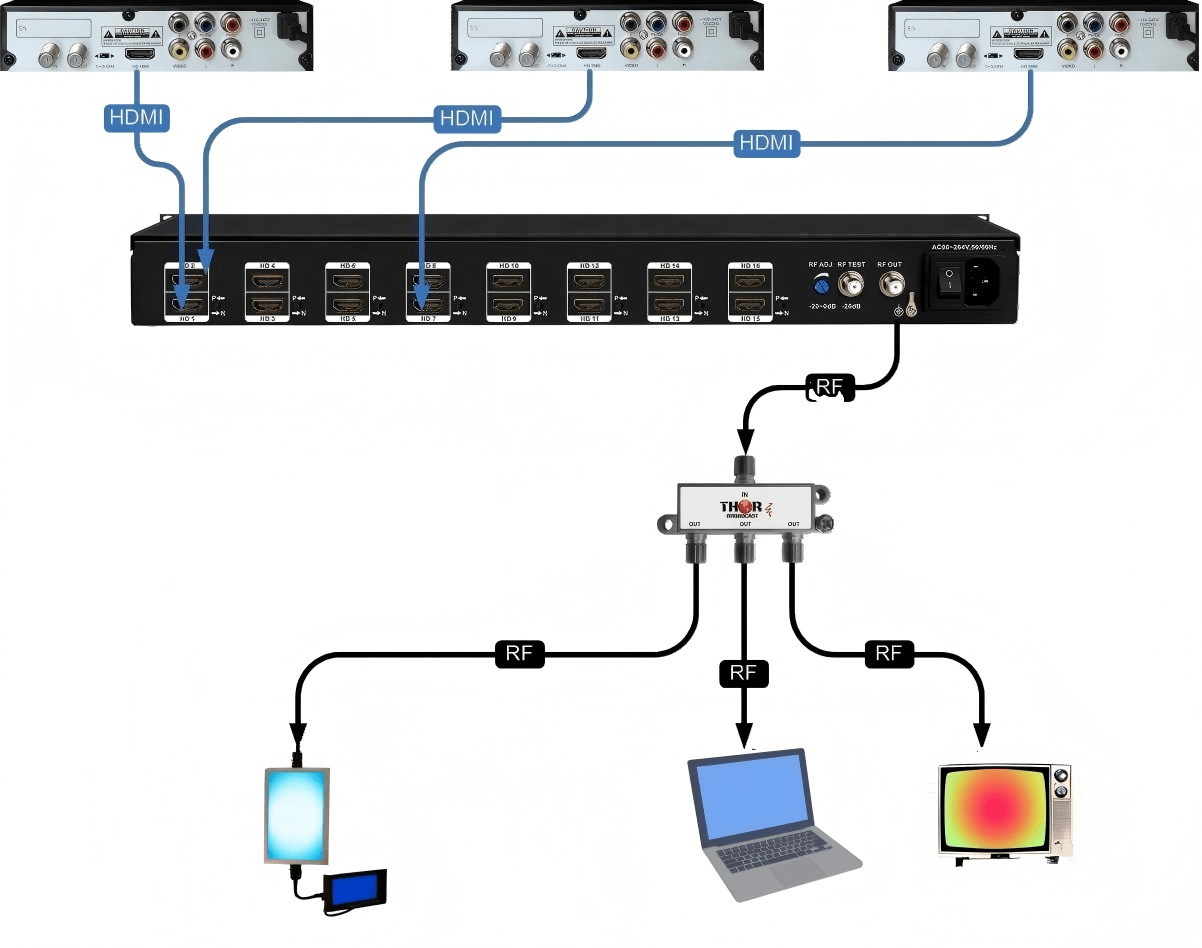
Curious about the HDMI RF Modulator? Learn how HDMI RF modulators convert HDMI signals into RF for c