Engineer’s Perspective — Selecting & Applying Circuit Board Components for Performance & Reliability
Introduction – Why Circuit Board Components Define PCB Performance & Supply Chain Value A bare

In today’s fast-paced hardware development environment, R&D teams face relentless pressure to innovate and bring products to market faster. Yet a significant portion of engineers’ valuable time is consumed by non-core logistical tasks — not design breakthroughs or technical problem-solving.
The traditional PCB development model is fragmented, slow, and labor-intensive. A typical project requires engineers to manage at least three separate partners: a PCB fabricator, a component supplier, and an assembly house. Each step demands constant follow-up, communication, and problem-solving — tasks that accumulate into hundreds of wasted hours annually.
One of the most time-consuming tasks is component procurement. Engineers must manually review BOMs, cross-reference part numbers across multiple distributors, verify stock availability, compare lead times, and negotiate pricing. For a 40-line BOM, this process can take 10–15 hours per prototype run — before accounting for obsolete parts, long-lead components, or last-minute substitutions.
Coordinating multiple vendors is another major time sink. Engineers must align schedules between fabricators, component suppliers, and assemblers, track delivery statuses, and resolve miscommunications. A single delay — late bare boards or missing components — can trigger a chain reaction of follow-up emails, phone calls, and schedule adjustments.
Logistics management further drains resources. Engineers must arrange shipping between vendors, track packages, and inspect incoming materials for damage or defects. If bare boards arrive damaged or components are faulty, the entire project grinds to a halt.
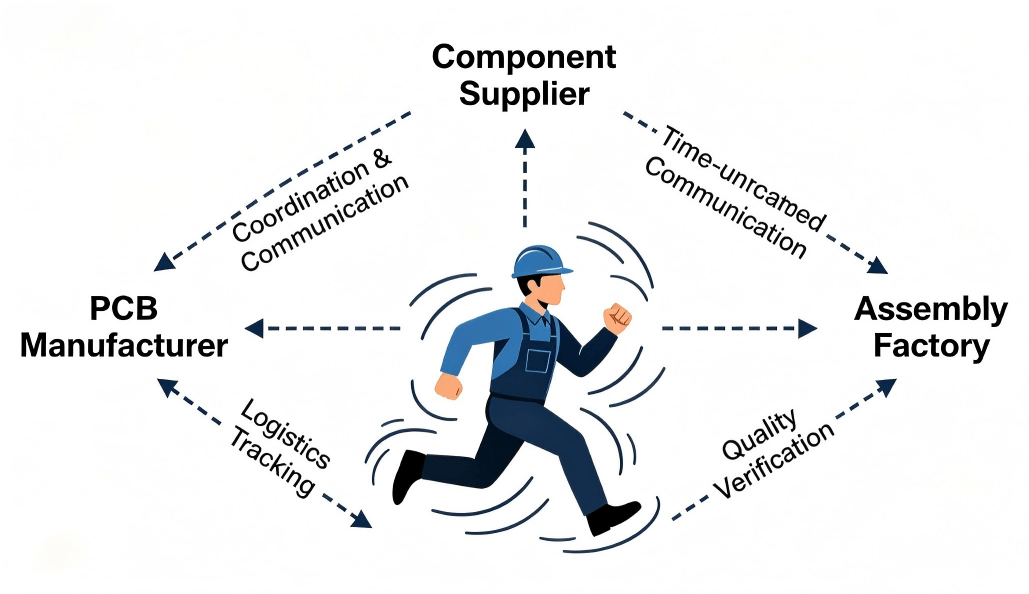
The Fragmented Traditional Workflow
Turnkey PCB assembly flips the script by placing the entire PCB lifecycle — from design review and component sourcing to fabrication, assembly, testing, and delivery — under the responsibility of a single, specialized provider. This integrated model eliminates redundant tasks, streamlines communication, and leverages expertise to automate workflows — saving R&D teams hundreds of engineering hours annually.
Turnkey providers maintain global supplier networks, real-time inventory databases, and dedicated procurement teams — eliminating the need for engineers to source components manually. When R&D teams submit a BOM, the provider’s system instantly validates part availability, pricing, and lead times across authorized distributors.
If parts are out of stock, the procurement team proactively identifies compatible substitutions with the engineer’s input — saving 10–15 hours per BOM. For teams running multiple prototype iterations per year, this alone can add up to hundreds of hours saved.
With turnkey services, R&D teams work with one dedicated point of contact for the entire project — replacing endless emails, calls, and follow-ups with multiple vendors. This single contact provides real-time updates on fabrication, assembly, and testing progress, resolves issues proactively, and ensures alignment at every stage.
Engineers no longer spend hours coordinating schedules or resolving miscommunications; instead, they receive a single timeline and a single source of accountability.
Traditional workflows are linear: components are sourced first, then PCBs are fabricated, then assembly begins — often taking 6–8 weeks per prototype. Turnkey providers run these steps in parallel: while PCBs are being fabricated, components are sourced and kitted simultaneously.
This parallelization can reduce prototype lead times significantly — from weeks to days. For engineers, this means faster design validation and more iterations per quarter — without spending extra time on coordination.
Turnkey services include comprehensive, automated testing at every stage: Automated Optical Inspection (AOI) for solder defects, X-ray inspection for hidden joints (e.g., BGAs), and functional testing to validate performance.
All tests are conducted in-house, with detailed reports provided to the R&D team. Engineers no longer spend hours manually inspecting boards or troubleshooting quality issues — they receive fully tested, validated PCBs ready for integration.
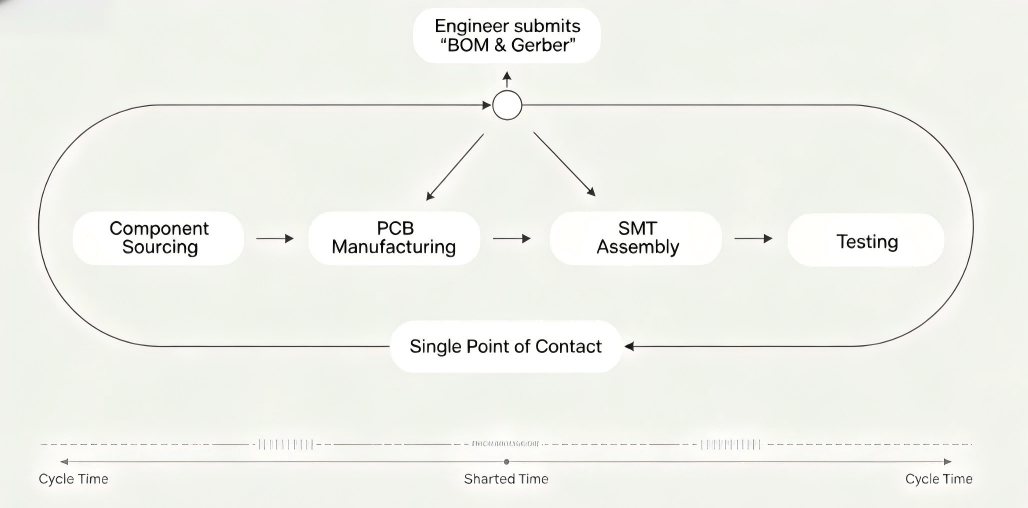
The Integrated Turnkey Workflow
Once R&D teams validate a prototype, turnkey providers seamlessly scale to low-volume or mass production — without requiring engineers to source new vendors or revalidate processes. The same team that handled prototyping manages production, ensuring consistency and reducing transition time.
This eliminates the hours of vendor research and onboarding required in traditional models.
The time savings from turnkey PCB assembly translate directly into tangible business and innovation outcomes:
Faster Innovation Cycles — Engineers can iterate designs more times per year, accelerating time-to-market.
Focus on Core Expertise — Time previously spent on sourcing and coordination is redirected toward firmware development, performance optimization, and next-generation research.
Reduced Burnout — Eliminating tedious logistical tasks reduces engineer fatigue and improves retention — critical for small R&D teams.
Lower Project Risks — Faster prototyping and early issue detection reduce the risk of costly late-stage failures.
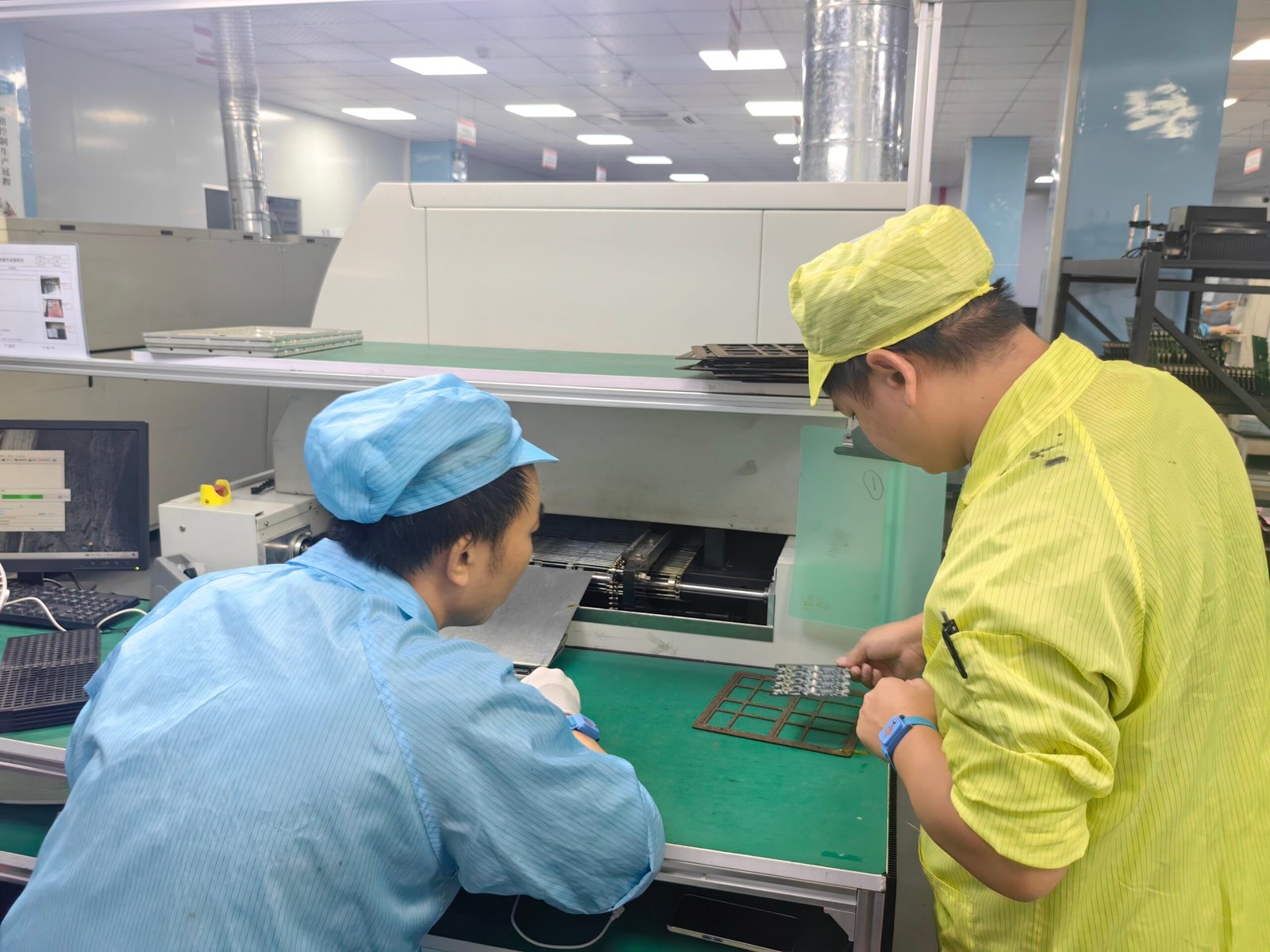
At Guangzhou Huachuang Precision Technology Co., Ltd. (HCJMPCBA), we have built our business around making hardware engineering more efficient. Our nearly 2,500 m² of ESD‑protected workshop space, multiple high-speed SMT lines, DIP plug-in and assembly lines, combined with ISO9001 quality management and ISO13485 medical device quality management certifications, provide the foundation for reliable, end-to-end PCBA services.
Our turnkey offering covers the entire lifecycle:
Component sourcing — We maintain relationships with authorized distributors and manage the entire procurement process, from BOM validation to delivery.
PCB fabrication — Our manufacturing capabilities support complex, multi-layer boards with consistent quality.
SMT assembly and through-hole — High-speed placement and selective soldering for mixed-technology boards.
Comprehensive testing — AOI, X-ray inspection, ICT, and functional testing — all in-house.
Scalable production — From pilot runs of a few dozen boards to mass production of tens of thousands per month.
Our intelligent MES system provides full component-level traceability, and our engineering team provides upfront process parameter recommendations before your first board enters the line. We maintain transparent quality reporting with complete traceability documentation — giving procurement teams the audit-ready records they need.
For R&D teams, time is the most valuable resource — and turnkey PCB assembly services protect that resource by eliminating the non-core logistical work that drains hundreds of engineering hours annually. By consolidating the entire PCB lifecycle into a single, expert-managed workflow, these services streamline sourcing, coordination, testing, and scaling — freeing engineers to focus on what they do best: innovating and building the future of technology.
If your R&D team is ready to reclaim hundreds of hours and accelerate innovation, HCJMPCBA’s turnkey PCBA services deliver the integrated expertise, sourcing networks, and end-to-end support you need. From rapid prototyping to scalable production, we handle every detail — so you can focus on breakthrough design, not logistical headaches.
Introduction – Why Circuit Board Components Define PCB Performance & Supply Chain Value A bare
Unlock the future of pcb assembly with 7 bold innovations in surface mount technology (SMT) designed

Explore what pcb design services entail—from schematic creation to Gerber file outputs. This compr