The global electronics supply chain has just received another severe wake-up call. Kingboard Holdings Limited (KB), one of the world’s dominant forces in Copper Clad Laminate (CCL) manufacturing, has officially declared its 7th price increase of the year.
However, this announcement sent shockwaves far deeper than the previous six. While prior adjustments historically hovered around a manageable 10% increment, KB broke the pattern by executing a steep 15% price spike.
For hardware engineers refining their latest prototypes and corporate procurement managers balancing strict quarterly budgets, this sudden escalation raises immediate, pressing questions. Why is this happening now? What does this mean for downstream Printed Circuit Board Assembly (PCBA) costs? More importantly, how can your production pipeline absorb this shock without delaying market delivery?
Part 1: Deconstructing the 15% Jump — Why the Shift in Aggression?
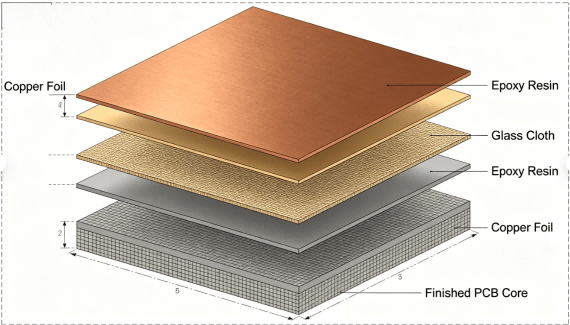
To understand the sudden 15% surge, we must look at the foundation of the Printed Circuit Board (PCB) itself. A Copper Clad Laminate (CCL) represents up to 30% to 40% of a bare PCB’s total manufacturing cost, depending on the layer count and copper thickness. The CCL market is highly consolidated, meaning when a giant like KB shifts its pricing structure, the entire electronics industry feels the immediate downstream pressure.
The move from the traditional 10% buffer to a rigid 15% hike is driven by several compounding macroeconomic factors:
-
The Copper and Resin Surge: The global green energy transition (electric vehicles, solar grids, and AI data center expansions) has triggered massive industrial competition for high-purity copper foil. Concurrently, specialized epoxy resins—the structural binding agents in standard FR4 boards—have experienced localized supply constraints, driving upstream chemical pricing to multi-year highs.
-
Energy Grid Adjustments: Base manufacturing for raw laminates is highly energy-intensive. Evolving carbon-emission policies and seasonal industrial electricity adjustments across major manufacturing hubs have significantly elevated the operational overhead per square meter of laminate produced.
-
The Artificial Intelligence Demand Pull: The exponential deployment of AI servers and high-speed computing hardware requires advanced high-TG, low-loss, and ultra-thin laminates. Tier-1 laminate manufacturers are heavily prioritizing their high-margin production lines for high-frequency materials, restricting the production capacity available for standard industrial FR4 materials and driving up market premiums.
Part 2: The Downstream Ripple Effect — What This Means for Engineering & Procurement
When a primary material provider raises prices by 15%, the impact does not stay confined to raw laminates. It creates a cascading economic effect down the electronic manufacturing service (EMS) value chain.
1. For Corporate Procurement Managers: Margins Under Seige
If you are managing the bottom line for enterprise hardware procurement, a 15% laminate increase typically translates into a 5% to 8% direct cost increase on standard bare PCBs. When compounded with global logistics inflation and fluctuating component pricing, your existing product profit margins can shrink unexpectedly. Budget projections set at the beginning of the fiscal year must now be dynamically adjusted to prevent unbudgeted cost overruns during high-volume mass production.
2. For Hardware Engineers: The Rigidity of the BOM
Engineers frequently face a difficult choice when raw materials fluctuate: do they stick to their specified stack-up or look for alternative laminates? Changing specified board materials (such as moving from a specialized KB grade to an equivalent alternative vendor) is never a simple clerical update. It requires validating electrical characteristics, thermal performance, and signal integrity. Under high-frequency or high-power constraints, a hasty laminate substitution can compromise the product’s field reliability.
3. Immediate Lead Time Volatilities
Price hikes are historically accompanied by a psychological phenomenon in supply chain management: panic stockpiling. As smaller PCB shops scramble to purchase remaining lower-cost laminate inventory before the 15% rate takes full effect, raw material lead times widen. A standard 5-day bare board fabrication cycle can easily extend to 12 or 15 days, effectively disrupting your planned product assembly schedules.
Part 3: How HCJMPCBA Protects Your Production Line from Market Crises
In times of raw material turbulence, the true value of a contract manufacturing partner is defined by their supply chain resilience and proactive risk mitigation.
At Guangzhou Huachuang Precision Technology Co., Ltd. (HCJMPCBA), located within the Pacific Industrial Zone of Zengcheng District, Guangzhou, we maintain that price increases should not automatically result in immediate, disruptive financial penalties for our clients. Through calculated resource planning, long-term industry relationships, and structured engineering controls, we actively work to isolate our clients’ active projects from sudden upstream volatility.
Here is how our factory handles material shocks to keep your manufacturing steady:
1. Strategic Blanket Orders and Long-Term Material Contracts
We do not purchase materials strictly on an ad-hoc, spot-market basis for our long-term clients. Because we handle regular turn-key project volumes across industrial, power electronics, and high-reliability sectors, HCJMPCBA maintains structured annual purchasing agreements with major tier-1 PCB fabricators. When a price hike occurs, our pre-negotiated material buffers allow us to delay or absorb localized price shocks for scheduled production contracts, providing procurement teams with critical pricing predictability.
2. Complimentary DFM & Smart Material Equivalency Engineering
If standard materials become cost-prohibitive or face extended lead times due to market hoarding, our engineering division steps in immediately. We provide comprehensive Design for Manufacturing (DFM) reviews to assess if alternative, highly reliable laminates (with identical Tg, Td, and dielectric constants) can be safely utilized without altering your circuit behavior. This engineering flexibility ensures you are never bottlenecked by a single vendor’s capacity or localized pricing strategies.
3. Integrated Turn-Key Operational Efficiency
Because we control the entire loop—from PCB layout verification, component sourcing, through to 100% automated SMT/DIP lines, 3D SPI, 3D AOI, and X-Ray analysis—we balance cost spikes by optimizing assembly efficiency. By minimizing internal manufacturing waste, maintaining high first-pass yields, and shortening production changeovers, we extract cost savings directly from our operational processes to neutralize external component and material inflation.
Part 4: Practical Action Plan for Engineering and Procurement Teams
To ensure your upcoming electronic hardware rollouts remain on schedule and within financial guidelines over the next two quarters, we recommend implementing the following adaptive supply chain steps immediately:
-
Lock in Forecasted Volume Approvals Early: If you have confirmed production builds scheduled for the next 3 to 6 months, avoid waiting until the final weeks to place production orders. Approving your projects early allows us to secure raw laminates at current, pre-hike tiers before regional distributor stocks fully reflect the new 15% premium.
-
Establish a Multi-Tiered Material Specification: When designing multi-layer boards or high-density interconnect (HDI) structures, work with your design team to define acceptable equivalent material cross-references directly on your fabrication drawings. Specifying alternative laminate vendors gives your manufacturing partner the tactical flexibility to bypass localized material shortages.
-
Consolidate Your Supply Chain: Managing separate vendors for bare PCB fabrication, component kitting, and final SMT assembly amplifies cost exposures during market inflation. Transitioning to a unified, turn-key manufacturing model allows an integrated partner to leverage their total purchasing power across all production inputs to shield your individual program margins.
Conclusion: Turning Volatility into a Competitive Advantage
Market shifts like Kingboard’s sudden 15% price adjustment serve as a practical reminder that hardware success requires more than a functional schematic—it requires a dependable, resilient manufacturing partner capable of navigating real-world supply chain pressures.
At HCJMPCBA, we combine advanced technical execution with transparent, strategic supply chain management. Our focus is to ensure that external raw material fluctuations never compromise your delivery timelines, engineering standards, or market competitiveness.
👉 Unsure how the latest KB price hike affects your active or upcoming production runs? Read our comprehensive engineering breakdown on PCB material optimization on our technical insights portal: https://hcjm-pcba.com/
📩 Take Control of Your Next Production Cycle: Don’t let unpredictable material spikes compromise your project roadmap. Send your current Gerber files and Bill of Materials (BOM) directly to the HCJMPCBA engineering team today. We will provide a thorough, complimentary cost-optimization and DFM review within 24 hours to secure your production line against market volatility.